THE ORIGINAL APPLE

FTAlmanac
- November 20, 2025
Kazakhstan is a Shangri-La that deserves
to be on your 2026 itinerary. It’s an ancient
land — from where the apple and the horse
originate — but now full of contemporary
galleries, cafes and architecture, finds
architect and quiz master Kunal Savarkar
By Kunal Savarkar
I
am by no means a global traveller, having visited
perhaps a dozen or so countries, largely thanks to my
work as an architect. My family and friends know me
as a geography-cum-history buff, and a quiz master. But
that is a cerebral, sedentary passion, translating into miles of
filled bookshelves and many hours down the rabbit hole of
the internet, which I trawl for stories, trivia and interesting
hyperlinks that lead me to more stories, trivia and interesting
hyperlinks. All in all, a month before I packed my bags for
Kazakhstan, I wouldn’t have believed it possible. It was one
of those fortuitous opportunities that seem to come to those who wait (or not), and it took me both by surprise as well as
to the airport. That a trip planned in such great haste should
turn out to be five wondrous days in a land seemingly in the
middle of nowhere is nothing short of serendipity.
Arriving by an Air Astana flight from Mumbai, while
landing at Almaty, my first views are those of gorgeous
snowcapped peaks of the Trans-lle Alateu, the northern part
of the Tian Shan mountain system. The nation does not offer
visa on arrival; it is straightforwardly visa free. Which means
you waltz in, free to wander across the endless steppes and
plains, and indulge in its enchanting culture, a delightful mix
of Central Asia and Europe. My travels began and ended in
Almaty, the former capital, and Kazakhstan’s largest city.
Babur, known to history as the first Great Mughal, but whose
Turkic roots were dear to him, mentions Almaty – Almatu
in his native Chagatai tongue – while locating his beloved
Fergana in the very first page of his Baburnama. He observed
that Almatu and Otrar were dead civilisations as a result of
Genghis Khan’s marauding hordes. The name Almaty itself
is derived from ‘alma’, the Kazakh word for ‘apple’; the wild
apple Malus sieversii, ancestor of the modern apple, grows in
the forests surrounding the city
Kazakhstan, called Qazaqstan in the Kazakh language, is
the ninth largest country and largest landlocked country in
the world. Located in the very heart of Central Asia, the vast
Kazakh Steppes were where the horse was first domesticated,
a historical event that changed the way the ancient world
travelled, traded, and fought. Interestingly, the words Kazakh
and Cossack both share the same Turkic root, mean free man,
wanderer or conqueror.
It was a vital section of the ancient Steppe Route, the
precursor of the Silk Road by two millennia, which ran ten
thousand kilometres from the mouth of the Danube River on the Black Sea up to the Pacific Ocean, and then the Silk
Road itself. The city of Almaty lay on the Silk Road, one of
the northernmost cities in Central Asia. The Russians called
it Alma-Ata, and made it the capital of the Kazakh Soviet
Socialist Republic from 1936 onwards. During World War
II, it received so many Russian thinkers, writers and other
intellectual exiles, including Leon Trotksy, that at one time,
there were more Slavs than ethnic Kazakhs in the city. Till
date, that syncretism continues, and modern Almaty is a land
of minarets, churches and avant-garde architecture.
Mithun Mania in Central Asia
Coming to a nation whose very name means ‘to wander’, it
was perhaps apt that I travelled hundreds of kilometres across
seemingly endless plains on beautiful highways. It may not
appear so, but Kazakhstan’s area is not much smaller than
that of India. one of the least densely populated nations on
the planet. Traffic is predictably sparse. Almaty’s wide clean
streets reminded me of Europe; but the cleanliness and order
would not be out of place in Japan. The city lies on a plateau,
around the same altitude as Bengaluru, but more than 30°
north of it, almost halfway to the north pole.
In Almaty, you can visit the newly-opened Almaty
Museum of Art, the St. Sophia Cathedral and the Ascension
Cathedral. The latter, built in 1907 using spruce from the
nearby Tian Shan Mountains, is touted by locals as the second
largest wooden building in the world. You may consider that
as an interesting bit of trivia, but a truly eye-popping one is
that the wooden structure is built with no nails (probably due
to their association with the crucifixion of Jesus), and, get this,
it survived an earthquake with a force of 10 points in 1911.
Equine dishes, shalgam salads, and
supermarket Snow Queen vodka!
Kazakh cuisine is a soulful reflection of its nomadic roots
— hearty, wholesome, and deeply satisfying. Born from
a lifestyle that valued preservation and nourishment, the
food celebrates high-protein meats, rich broths, and honest,
uncomplicated flavours. The soups are clear and comforting,
whether it’s a meaty broth (beshbarmak, a meat-and-noodle
dish, is the Kazakh national fare) or a velvety lentil version
that warms the soul and fills the belly. Even modern fast food
here carries the essence of tradition, offering familiar tastes
with a rustic twist. The fish, astonishingly fresh and tender,
melts on the tongue, while the famed horse meat — a local
delicacy — is succulent, soulful, and unforgettable. Kazy/
qazi, lagman, and kuurdak are equine dishes. Every bite tells
a story of the steppe — simple, pure, and irresistibly full of
heart. And while the land is an obvious haven for meat eaters
increasingly there is much on offer for vegetarians too. The
local radish is called shalgam, and is a key ingredient in a
Kazakh salad! A popular Kazakh rice dish is the palaw (pilaf/
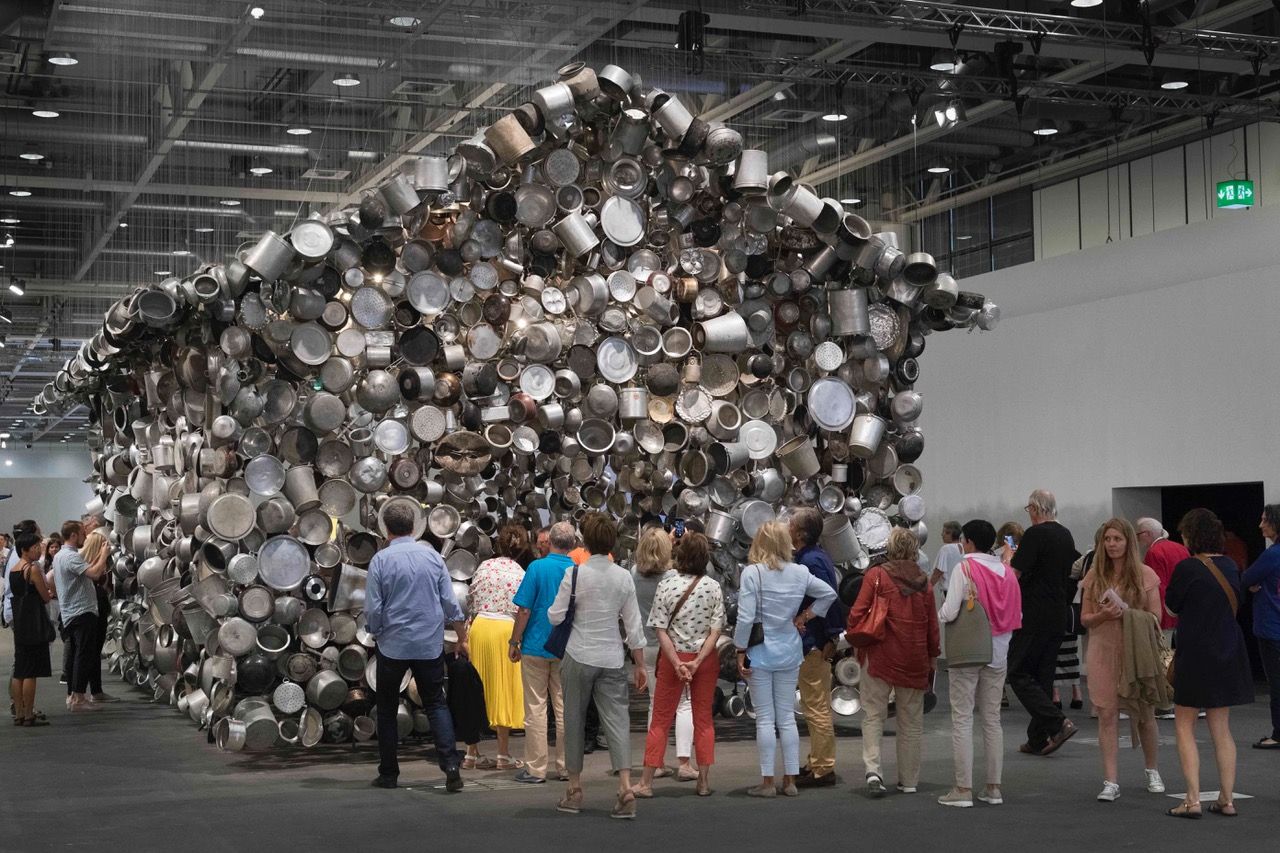
pulao), cooked in the traditional qazan, the simple, often sole,
cooking pot of a nomadic people. Nan, cooked in the tandyr
(no points for guessing the Indian words!) has travelled
through the annals of history and all along
the Silk Road to modern times.
The local radish is
called shalgam, and
is the key ingredient
in a Kazak salad! A
popular Kazak rice
dish is the pilaw
(pilaf) cooked in the
traditional qazan
The world’s second coldest capital…
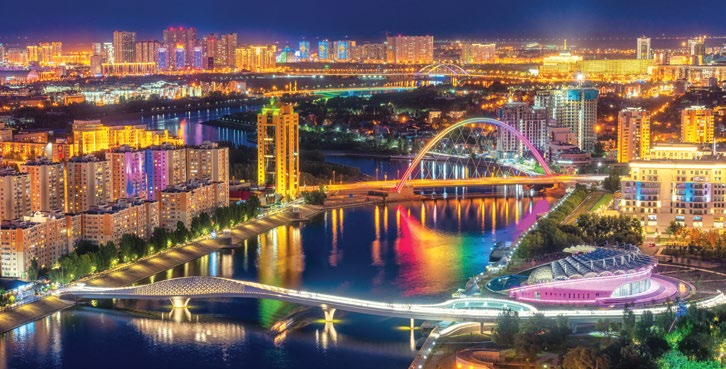
A seemingly endless day trip took me to Astana, a city whose masterplan was made by Japanese
architect Kisho Kurokawa. A relatively
new city, quaintly enough, Astana’s name
means ‘capital city’. It also quirkily holds the
Guiness World Record for the capital city
with most name changes in modern times,
having been through Aqmola, Tselinograd,
Nursultan, and again, Astana! The city, which
has hosted the Winter Olympics, is also the
second-coldest capital city in the world after
Ulaanbaatar (capital of Mongolia). There
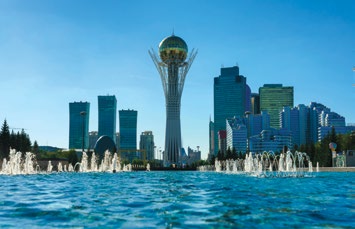
are several iconic architectural masterpieces
here, including the 105m tall observation
tower Baiterek, the tent-shaped Khan Shatyr entertainment
centre, the National Museum and others, and to my surprise,
I found it to be a bustling modern city attracting young
professionals from all over the region, including Russia.
Taxis are easy to book using the Yondex app. In Almaty
there are gleaming tramlines and buses. There is a metro
under construction in Astana with magnificently ornate
stations, befitting its unique architecture. I debated writing
this article, aware that doing so might lead to an avalanche of
visitors to this Shangri-La-esque nation, which could of course
lead to the mindless hypertourism that has overtaken Venice,
or Bali, or Thailand. On the other hand, it seems strangely
selfish to keep such a gem hidden, for Kazakhstan demands
to be visited and explored, a rugged paradise, a melting pot
of eastern and western cultures.