How An Island Became A Family Deity


The link between Socotra and Sikotar Mata, the
deity of India’s ancient sailors, reveals a forgotten
history of early Indic travel by the Lohana traders
of Gujarat, who sailed the Indian Ocean, trading
in cotton and spices, bringing back cargo that
may have included Arabian horses, pearls, coffee,
ivory, rhinoceros horn and tortoiseshell, on ships
propelled by the monsoons and some faith.
By Vir Kotak
Outside the city limits of many slow-paced littoral
towns of Kathiawar, Gujarat, lie some almostforgotten sacro-cultural shrines dedicated to Sikotar Mata, the deity of sailors, seafarers
and maritime traders — effectively, the protector of ocean
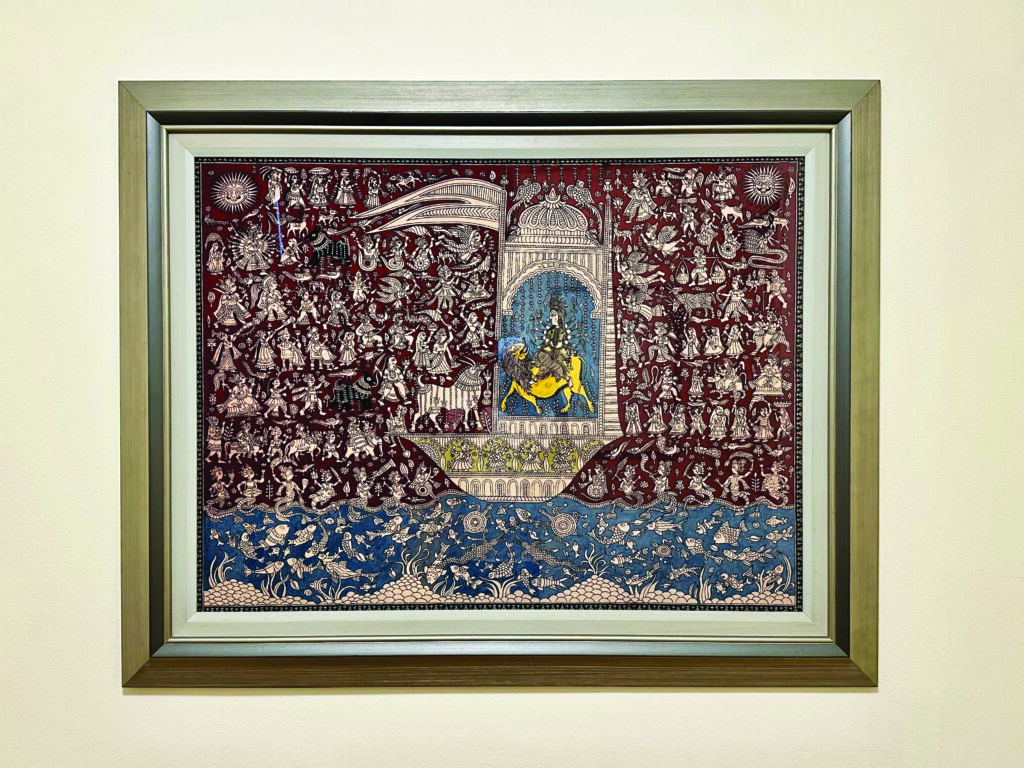
adventurers. Sikotar Mata, in many pictorial representations,
is seen atop a lion, itself gracefully perched atop a ship, sailing
across the seas swarming with creatures. She is the centre
of the scene – a most regal countenance. Who is this most
fascinating, powerful, yet merciful benefactor? And just who
are these people to whom she was, and remains, a benefactor?
The answers lie in a deeper, more layered probing of a
region that wasn’t just a demarcated state in the west of the
modern republic we know today, but a collection of dynamic,
thriving nodes of different interconnected trading and
cultural networks.
Socotra, an island that is recognised internationally as part of the presently politically-troubled country of Yemen, is a
wonder, however one approaches its existence. The island is truly “adrift” – triangulated between the Horn of Africa and
the southern Arabian Peninsula. Socotra lies approximately
125 nautical miles from the nearest mainland. Over the
millennia, that isolation has produced a distinct and diverse
endemic flora and fauna, and one of the most stunning
landscapes in the world. Today, outside of evolutionary
botanists and the stray off-the-beaten-track thrill-seeker, the
relevance of its location is not so evident. But then we aren’t
seeing it in the frame of another age — a pre-colonial age,
when the waters of the Arabian Sea were teeming lanes of
commerce, trade, knowledge transfer, expedition and life.
The Lohanas, a community not originally
native to the Kathiawari coast, can usefully
be thought of as the “producers”
of some of these voyages.
Opportunistic, adaptable and
lettered, this warrior-merchant
community could occupy the
space between the state and its armed actors, established Jain financiers and traders,
and the stevedores and sailors who supplied the physical
labour. As with much of subcontinental “history”, the
origins of the community are recounted primarily through
oral community retellings, with little published scholarship
on the subject. Within those archival limitations, community
traditions place the origins of the Lohanas along the western
frontier of the Indic realm, the harsh desert climes of Sindh,
possibly even farther afield.
West of Sindh, in present-day Balochistan, Pakistan,
is an ancient cave temple dedicated to Hinglaj Mata – the
Hinglaj tradition belongs to a sacred geography considerably
older than the presently identifiable Sikotar Mata shrines
of Kathiawar, while also representing a manifestation of
Shakti, the female embodiment of absolute divinity. Most
interestingly, Hinglaj Mata has been the kuldevi of several
Sindhi Lohana lineages, many of whose members left
Pakistan following the Partition of British India.
Sindh lies on the southern reaches of the centuries-old,
land-based, east–west Silk Routes, and its bankers and traders,
many belonging to the Sindhi Lohana community, did not
merely benefit from their location upon thriving commercial
routes. They were active participants far beyond Sindh,
using their own node to enter a much larger interconnected
overland world. Within it, the promissory notes of prominent
Sindhi banking families could be honoured and traded
thousands of kilometres from home. But in medieval times,
passage through mountains, deserts and the territories of
different states and quasi-states was perilous. Caravans
crossed endless roads through sparsely populated country,
often carrying goods of substantial value. That unaccountedfor risk was balanced in the ledger, metaphorically, by the
presence of the divine, all-encompassing mother. When
invoked, Hinglaj Mata was relied upon to protect both the
traveller and his family back home.
The community probably migrated in multiple waves
over several centuries. Geography suggests that these
movements skirted the Thar desert, treating it less as a
landscape to cross than as a perimeter around which routes
developed. Movements between Sindh and Punjab are
harder to trace as a linear migration.
The movement most readily
reconstructed is that from Sindh into
present-day Kutch. In the world before
the republic and its borders, Kutch was
much closer to Sindh in its geography,
culture and desert-edge life. From Kutch
came further migrations south, deep into
the Kathiawar peninsula, also known as
Saurashtra. It was more closely integrated
into the normative Bharat of the time,
but remained at its edge – an edge that was itself a node in the broader maritime Silk Routes of the
Arabian Sea.
Over time, Gujarati Lohanas appear to have become
involved in several critical functions of the peninsula’s polities,
retaining or adapting these roles under Chudasama, Solanki
and Vaghela rulers, and later under the Muslim sultanates.
Community histories and surnames – read cautiously –
preserve a sense of the breadth of their activities – from local
landholders and fort lords to lettered treasury managers,
coastal traders and inland merchants. The Lohanas were not
at the apex of the polity, nor did they possess the financial
heft of the Gujarati Jain and Vania trading and moneylending
class. Some nevertheless became well-networked, landed
power players within the royal courts.
Their ability to be either or both – warriors and traders –
again allowed them to be opportunistic in this new homeland.
They could grab with both hands any lucky opening that
came their way. The move south into Kathiawar may also
have encouraged gradual assimilation into local Vaishnavite
traditions and, in some families, vegetarian practice. This
was likely a slow and convenience-based assimilation rather
than an abrupt religious transformation.
If the Sindhi Lohanas really came into their own in the
land-based trade routes west and north of their homeland,
the Gujarati Lohanas really stepped up their game on the
coast. Suddenly, the vastness of the ocean gave them access
to a much broader commercial world, with an improbably
long coastline full of points of departure from which to
send vahāṇs, or ships laden with goods, into a broader
world. Their appetite for adventure and long-distance trade,
combined perhaps with fewer ritual constraints upon sea
travel at this stage, may have given some Lohana merchants
an advantage in maritime commerce. Jain and Vania
merchants nevertheless remained formidable participants in the bustling overland networks east of the Thar desert,
connecting the peninsula to the great houses of Rajputana
and further north to the Punjab and Gangetic plains.
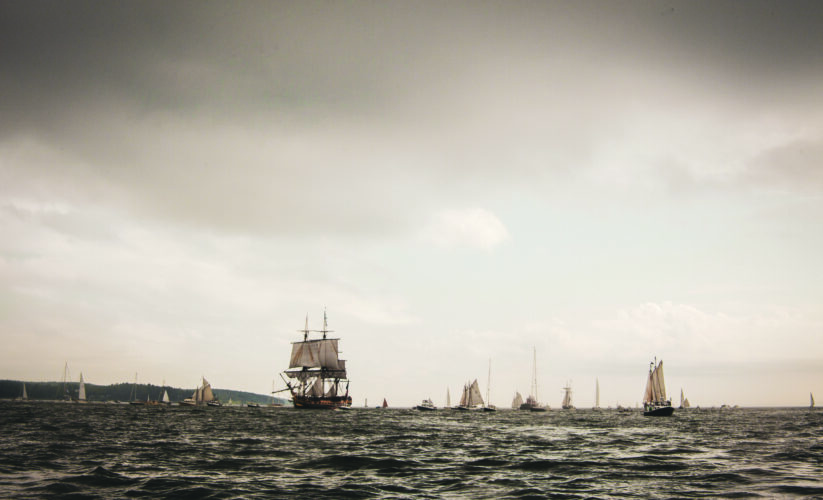
A plausible reconstruction of one such voyage might look
like this. In this pre-industrial, pre-colonial world, it would
be during the monsoon that a Gujarati Lohana sea-trader
would be busy preparing for the journey ahead. He would be
getting his vessel and its rigging shipshape,
and rostering the crew for the season.
He would need sufficient provisions of
food and water to reach the next landfall.
The cargo procured from a larger Vania
merchant in the mandi might include
bales of cotton textiles and yarn. He would
also be coordinating the terms of finance
and shipment with a Jain moneylender,
potentially his largest creditor. Various
family members might participate as investors, holding
stakes in subdivided
lots of cargo.
The southwest monsoon lay-up may
have been the longest
sustained period he had
with his family, who,
for the rest of the year,
would have to wait for
the chatter from the port
to learn whether he was
safe.
As soon as the winds
turned, possibly in
October, the ship would
be loaded, and the
expert sailors in the crew
would use the northeast
monsoon winds to carry
the vessel effortlessly
southwestwards.
And this is where it
really gets interesting! In today’s world, there are important
hubs such as Singapore and Dubai, because of the way they
use their locational advantage in hyper-connecting multiple
different points and routes. In a world that existed before
fast communication channels, and large colonial empires,
the island of Socotra was not just a random island adrift –
for a vessel sailing directly from Gujarat, it could be the
first major landfall after several weeks at sea; later Gujarati
inscriptional evidence records voyages from Ghogha lasting
approximately fifty days. proximately fifty days.
This was a journey that was incredible in its complexity,
uncertainty and levels of danger. Now
they had arrived, and a normal human
tendency is to offer gratitude, in awe of
something so much bigger than them –
and it is perhaps from here that the idea
of Sikotar Mata took root. The surviving
evidence does not record the moment
at which the island became personified
as the goddess; that connection remains
a compelling inference drawn from
the name, the voyage and the later
devotional tradition. She was the mother
to whom prayers for safe passage were
offered at shrines by the sea, and who,
nearly two months later, welcomed the
weary sailors to her island with open arms, having protected
them from perilous storms and murderous pirates.
There is a limestone cave on Socotra called Hoq that still
bears inscriptions from as far back as the second century CE
in Brahmi script identifying sailors and ship captains from
western India—including a captain from Bharukaccha,
modern Bharuch—who recorded their presence there.There
is no clear evidence linking these individuals to being part of Lohana-led expeditions, but it does unambiguously establish maritime activity between western India and the island.
It therefore seems reasonable to connect the dots and
propose that the origins of Sikotar Mata lie in Socotra. Her
adoption as a clan protector by some Lohana families brought
together the community’s history of voyaging with the elemental human desire
for a protective deity who
could grant fortitude and
resilience. To this day,
there are several Lohana
families who consider
Sikotar Mata their kuldevi
or divine clan protector.
The trader and his
crew could use Socotra as
a provisioning stop and,
just as importantly, as a
place to gather updated
market intelligence.
During their time
there, they could assess
opportunities in the ports
of the Red Sea, the Horn
of Africa, the East African
coast, the southern
Arabian Peninsula and
the Persian Gulf. This
information would help
him determine where to go next: a single destination or a
triangular trading circuit.
Depending upon the route and the century, the return
cargo would differ. Catching the southwest monsoon winds,
the ship could bring back dates, Arabian horses, pearls,
silver and metals from the Persian Gulf; coffee, frankincense,
myrrh and aloes from Arabia and the Red Sea; and ivory,
gold, hides, rhinoceros horn and tortoiseshell from the Horn
and East Africa. Only after the accounts had been squared
with the moneylender and counterparty merchants was the
journey commercially complete. The family members who
had invested in its cargo could then be
paid. His immediate family would feel
a profound gratitude for his safe return.
Over the monsoon, they would hear
about fantastical adventures in places
so distant that the wives and mothers, at
least, would likely never see them.
The Sikotar shrines outside
Kathiawar’s littoral towns are therefore
not merely local devotional sites. They
preserve both faith in a goddess and the
memory of a world in motion – a time
when the western edge of the Indic realm
faced outward, when Lohana merchants
followed the monsoon into a commercial
world stretching from the Persian Gulf and the Red Sea to
the Horn of Africa and the East African coast, and when faith
travelled with them.
Somewhere in that repeated passage, Socotra may have
become Sikotar: a distant island transformed into a mother,
protector and kuldevi, and the dangers of the sea answered
by the promise of protection. And so each shrine by the
sea could therefore also be seen as an archive – a surviving
marker of the journeys that shaped both the community
and its goddess. Her story reminds us that the histories of
communities are not contained by the borders of modern
nation-states. They are also written in winds, trade routes,
family memory – and in the deities brought home from the
journey.