Cooking is a Pure Form of Art

Jayasri Burman and Paresh Maity, creative partners in life and icons of Indian art, experienced two distinct aspects of food while growing up. Their memories and experience of eating and cooking are congruous with their artistic impulses.
By Rahul Kumar
There are ways in which creativity announces itself, through colour, through gesture, through the quiet insistence of a line becoming form. And then there are ways in which it arrives unannounced, simmering softly in a kitchen. For Paresh Maity and Jayasri Burman, partners in life and icons of the world of Indian art, food is not peripheral to creative journeys.
For Maity, the story of food begins not in abundance, but in absence. “I should not say, but it is true,” he reflects, his voice carrying neither bitterness nor embellishment. “I come from a very poor middle-class family. I cannot forget the days when I did not even know if I would get a proper meal.” Hunger, in his telling, is not metaphorical. One among six siblings, he grew up in a household where food was uncertain, where each meal was not assumed but awaited. That first encounter with lack has never quite left him. Instead, it has transformed into a kind of quiet discipline. “To date, I feel that if I am getting food to fill my tummy, then why can’t I work hard and make the best art?” he says. Food, here, is not indulgence; it is permission, even obligation, to give back through labour, through art.
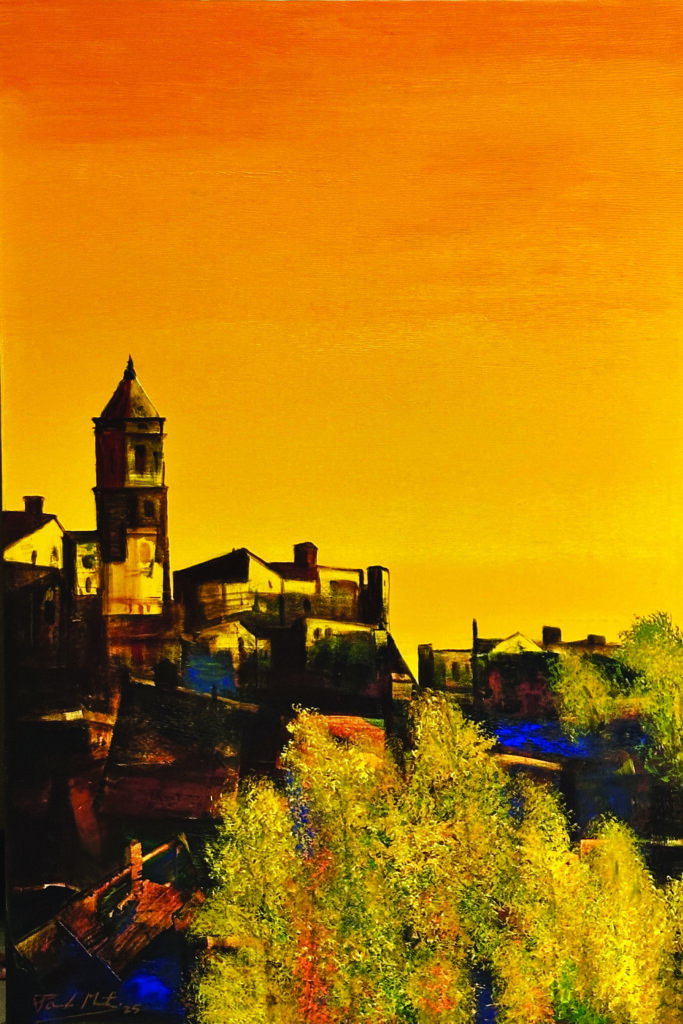
His memory also returns in flashes of ritual, of sound, and celebration around food. Maity recalls the festival of Annapoorna Pooja, to honour the goddess of nourishment. “I was in Calcutta yesterday,” he says, “and there was some celebratory music near my house… When I asked my family, they said, yes, it’s Annapoorna pooja. It immediately took me back to the old, old time.” For him, there is no hierarchy of dishes: “My mother always says never to refuse food. And that’s why… whatever I get, I eat. I do not fuss over dishes and what goes with what. If I get food, I simply eat it.” Stripped of ornamentation, this approach mirrors the directness and vitality of his painted worlds.
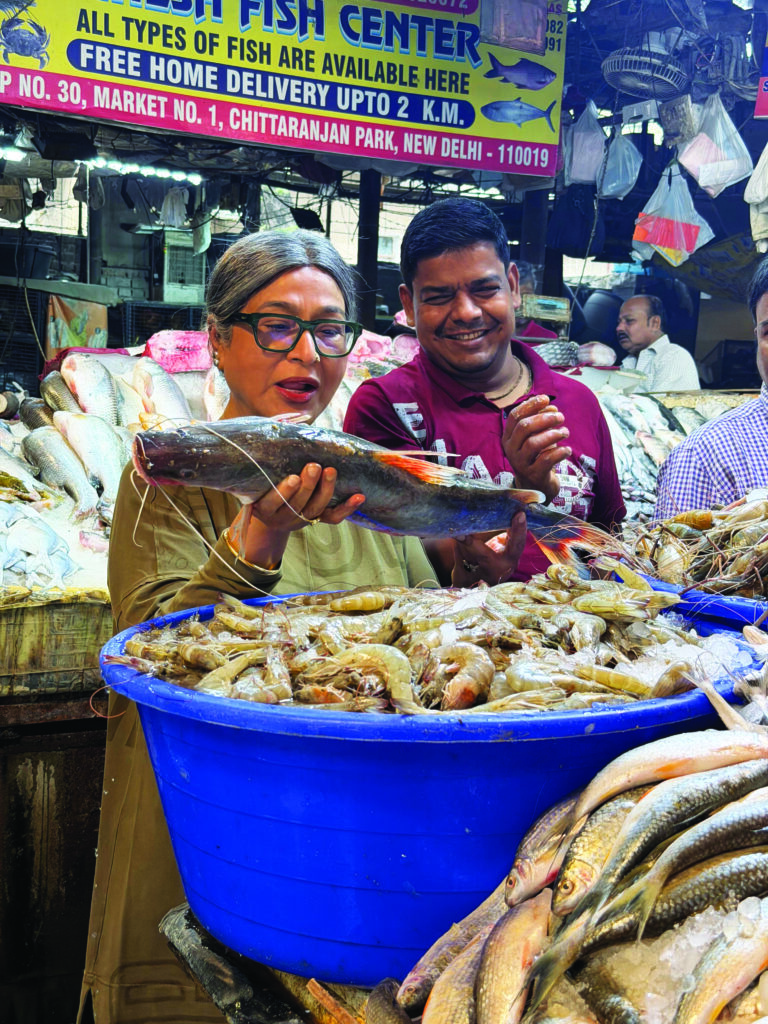
If Maity’s memories are shaped by hunger and humility, Burman’s unfold in abundance– of people, of colour, of sensory richness. Her earliest recollections are inseparable from place, from a street that doubled as a marketplace and a stage. “There was a footpath… and vendors sold vegetables and fish,” she recalls. “It looked beautiful, with colorful vegetables and fish in various shapes and sizes. It was like a drama happening on the street.”
In her telling, food is spectacle. It is visual before it is edible. The market becomes a living tableau, figures in dhoti-kurta, baskets brimming with produce, the choreography of buying and selling. Even more striking is the cast of characters: “Celebrity people, poets, filmmakers, artists… they all used to come.” Food, here, becomes a point of convergence, dissolving boundaries between the everyday and the celebrated. “My house had 20–25 people living at any given point,” she says. Cousins from Assam, Dibrugarh, Tripura, Bangladesh, an ever-shifting constellation of family. “Every meal was an event in my household. Multiple dishes, many textures, colors, aroma, and of course, banter and chitter chatter.” The table becomes a site of performance, of exchange, of joy. Food is not merely consumed; it is experienced collectively, woven into conversation and laughter.
Between them, Maity and Burman offer two different origin stories, one marked by scarcity, the other by
plenitude. Yet both arrive at a shared understanding: that food is never just food.
“Food is civilization,” Maity states, with the conviction of someone who sees continuity across time. He traces its presence through history: Mesopotamia, Greece, the Indus Valley, through cave paintings and miniature traditions, through the persistent motif of fish. “It is not merely that someone has to eat to survive… it is everything; also, it is art.” The act of cooking, for him, is itself a creative gesture. “Cooking food is a pure art form.” His gaze moves across geographies, attentive to variation. In India, he notes, diversity is not abstract; it is tasted. “Going from one place to another in India, every 100 kilometers you will see food change … not only inter-state but also within a state.” Food becomes a marker of identity, of region, of history, encoded in preparation, presentation, even the vessels in which it is served. It finds its way into visual culture as well: in mural paintings, in miniatures, in scenes of halwai shops and vegetable sellers.
Food as a medium for emotion
Burman approaches the question from another axis, one that is at once bodily and spiritual. “For me, food is energy,” she says. But this energy is not merely caloric; it is affective, almost metaphysical. Drawing from a teaching of Swami Vivekananda, she reflects, “The spirit of the one cooking, the one serving, gets transferred to the one eating.” Food carries intention. It absorbs mood. It becomes a medium through which emotion travels. “If I am not in a good mood,” she adds, “that vibration goes, when somebody is having that.”
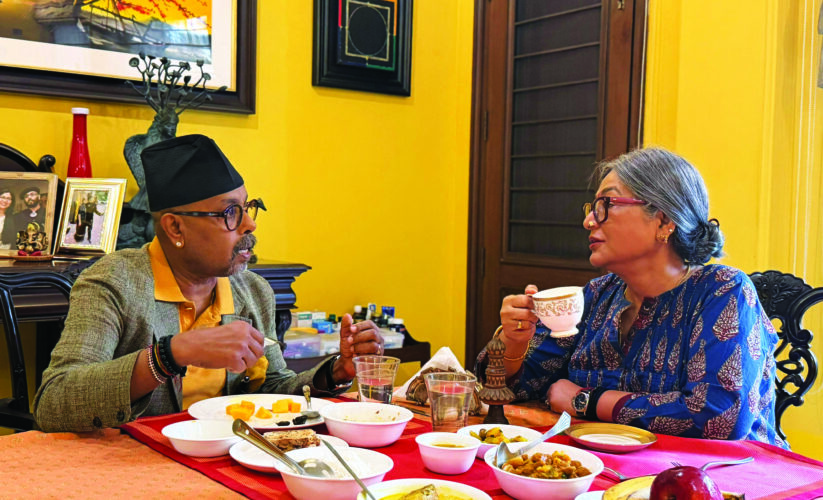
But food is also ceremony in Bengali households, as Maity observes: meals are orchestrated with anticipation. “They will have breakfast and talk about dinner,” he smiles at the cyclical devotion to planning and preparation. Serving itself is ritualistic, the shaping of rice, the sequencing of courses. “It is choreographed ceremony.” And yet, within this choreography, there is also intimacy. The couple may not cook together, “I should not acknowledge that,” he jokes, but they eat together whenever possible. The preference is simple: home-cooked meals, unpretentious yet deeply satisfying. Food here anchors domestic life, offering continuity amid the demands of artistic practice.
Burman’s relationship with cooking carries its own spontaneity. She recounts a recent moment in her studio during Navaratri, when a sudden craving led her to prepare sooji halwa. “My staff was thrilled,” she says, recalling their smiles. The pleasure, notably, is not only in cooking or eating, but in witnessing others enjoy what she has made. It is an extension of her artistic impulse, the desire to create something that evokes response, that generates joy. Her culinary repertoire is rooted in Bengali traditions, particularly the reverence for fish. “Fish is very precious to us,” she notes, describing techniques that honor its delicacy. At the same time, her life in North India has introduced contrasts, rituals like fasting during Navaratri, which she embraces even as she recalls her mother’s admonition: “Married women need energy and should never fast.” These tensions, between regions, between inherited beliefs and adopted practices, find quiet expression in the kitchen.
Some of their most evocative memories emerge from journeys, road trips that blurred the boundaries between travel, art, and sustenance. There is something almost cinematic in these recollections: an ambassador car
packed with ten people, doubling as both transport and kitchen; roadside halts near forests or canals; meals cooked under open skies. “We used to carry everything… whole kitchen units at the back,” Burman says. “At meal times, we would actually stop by… and cook.” On a Shivaratri night, she remembers, the scene was particularly luminous: “a moonlit evening and all women carrying an oil lamp, walking back from the mandir.” Food, in such moments,
becomes part of a larger sensory tapestry, light, sound, and movement.
These journeys often intersected with art itself. Travelling with artists like Ganesh Haloi, they would pause not just to eat, but to observe, to paint, to absorb the environment. “They used to paint, getting inspired by the scenery, and we cooked,” she says. “It was like an endless picnic.” And then there is the question of return. After travel, after exposure to the world, what does one long for?
Khichdi for every meal
The answer, for both, is disarmingly simple.
“Roti, sabji… proper home-cooked food,” Burman says. The specificity of dishes, fish, dal, aloo bhaja, carries emotional weight. “I’m on top of the world,” she adds, describing the satisfaction of a familiar meal prepared at home. Maity’s response is even more elemental: “I can eat khichdi in every meal. Our Indian khichdi is so good. Nothing like it.” Khichdi,
often considered humble, becomes in his telling a kind of ideal, comfort distilled to its essence.
In these preferences, one glimpses a deeper truth. For all its cultural complexity, its ceremonial richness, its historical depth, food ultimately returns us to simplicity. To what is known, what is remembered, what sustains.
In the practices of Paresh Maity and Jayasri Burman, this philosophy resonates beyond the kitchen. Maity’s work,
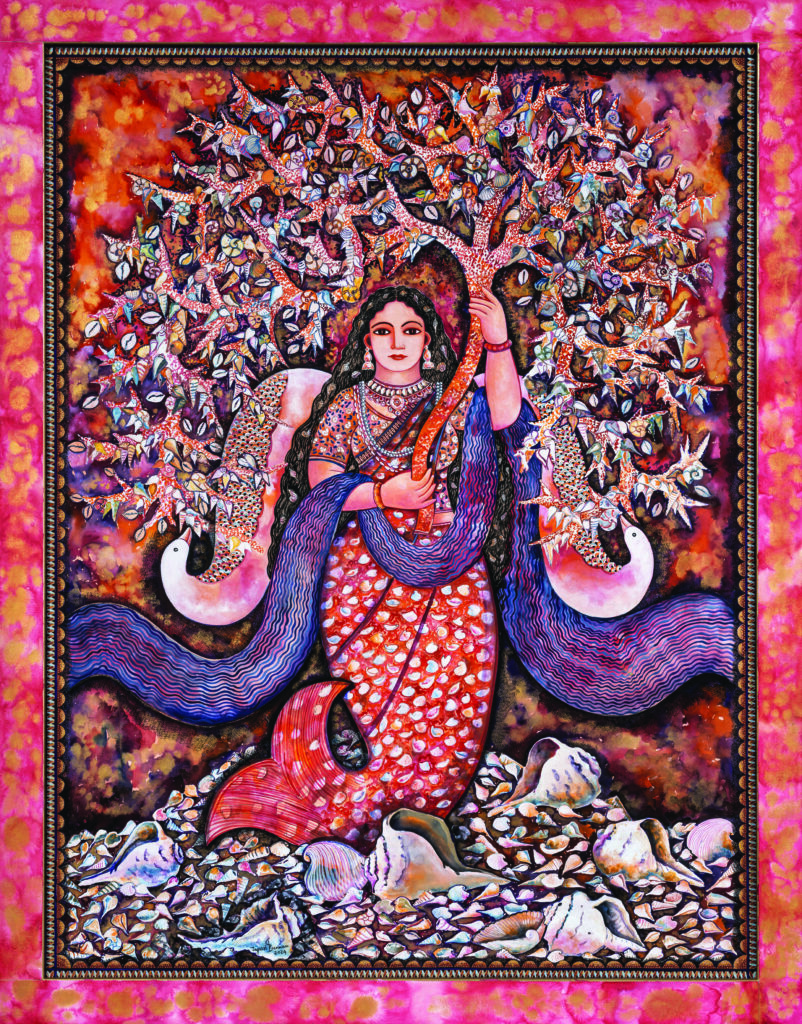
spanning watercolors, oils, and large-scale installations, often captures the vitality of landscapes and urban scenes, infusing them with rhythm and movement. There is an immediacy to his mark-making, a responsiveness that mirrors his unadorned approach to food. Burman’s visual language, by contrast, is richly symbolic, drawing from myth, folklore, and the feminine divine. Her canvases are populated with figures that seem to inhabit a dreamlike realm, where nature and narrative intertwine. Yet, like the meals she describes, her compositions are layered, with colour, with texture, with an almost tactile sense of abundance.
Together, they inhabit a shared world where art and life are not discrete. Food flows into memory, memory into image, image into expression. It is not incidental that both speak of food in terms usually reserved for art, composition, energy, and ceremony. Nor is it surprising that their recollections of meals carry the same vividness as their recollections of paintings.