
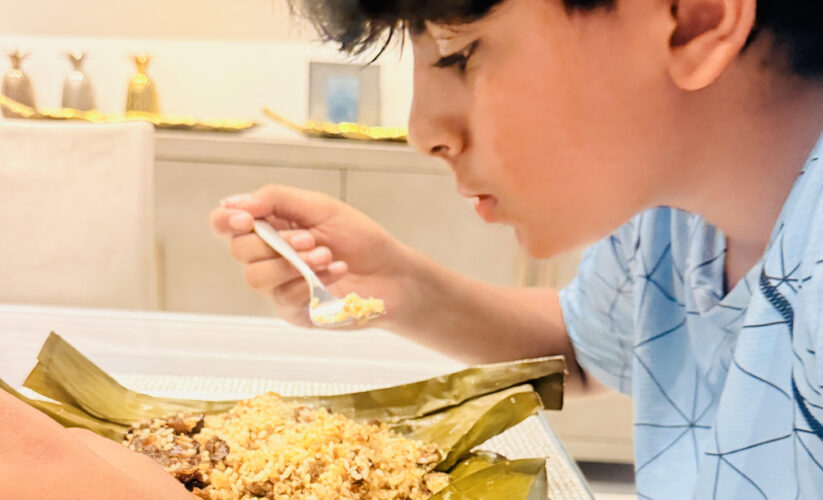

A young Lankan student offers us this quintessential taste of Lanka. Have you tried it yet?
By Aarish Hirdaramani
“A food to represent my country?” A new friend asked me this rather impossible question. What food can possibly capture the magical wonder and diversity of Sri Lanka, the paradise island I call home? What food can evoke a sense of this country’s history that has been influenced for generations by so many different cultures and tastes— the British, the Portuguese, the Dutch, Indians — besides the long continuous history of its own indigenous people? Confronted by this foodie question, my stomach rumbled; and the only dish that came to my mind was our beloved and delectable lamprais!
The word “lamprais” originates from the Dutch word, ‘Lomprijst,’ meaning lump of rice. It is succulent meat, seasoned with Sri Lankan spices, wrapped in a waxy banana leaf– almost like a Christmas present that is available all year round. My new friend did not know what was in store for him, when I took him out for a lamprais meal. It was evident that all his five senses were going to be stimulated by the dish representing different eras of Sri Lankan history.
I handed over the neatly folded lamprais and excitedly watched as he unwrapped the green fibres of the leaf to reveal the treasure. Simultaneously, I heard the gentle crinkling of the banana leaf. Then, we inhaled the aromatic lamprais. His amazed eyes focused on it to inspect the multitude of ingredients. Finally, taste, the most important of all the senses. I nervously watched as he took a generous bite of the lamprais. His eyes rolled, his mouth watered, and there it was, the classic ‘Sri Lankan smile.’ Not only do those who live here have it, those who visit, borrow it as well.
As I was preparing to take a hearty bite of my own lamprais, my friend awkwardly noticed me eating with my fingers. Instead of being embarrassed, I explained that many Sri Lankans believed in the ancient science of Ayurveda, which asserts that eating with our fingers enhances our connection with our food. After explaining this, I still respected that in his culture, maybe they didn’t follow the same traditions. So, I handed over some cutlery to him. Interestingly, he used a spoon for the rice and his hands for the tender pieces of meat, his own adaptation of both!
His Sri Lankan smile turned into laughter, I told him that lamprais tastes best when you have it with friends. I also explained that the ingredients differ depending where in Sri Lanka you have it. Not only is it diverse, it is also inclusive; it honors the past and welcomes the new. A ubiquitous ingredient is coconut because it is found in all parts of Sri Lanka. An ingredient that varies is aubergine, which can be replaced by plantains. Even though lamprais has been around for centuries, it keeps up with the trends. For example, jackfruit lamprais, suitable for vegans, has been invented. Lamprais is always evolving. Sometimes its ingredients are in perfect harmony, sometimes they’re imbalanced, but it’s perfect in its imperfection, just like Sri Lanka is to me.
So, where can you eat some legit lamprais? Here are some reccos that my mother and I prefer:
So, where can you eat some legit lamprais?
The Dutch Burger Union in Colombo!
FAVORITES FOR SRI LANKAN FOOD
Picks in Sri Lanka
- Palmyrah
- Ministry of Crab
Picks Abroad
- Hoppers, London
- Kolamba, London
QUINTESSENTIAL DINING EXPERIENCE
- Gallery Café, Colombo
WAITING TO TRY!
- Lungi (awarded a Michelin Bib Gourmand!), NYC
Picture above is lamprais from the Dutch Burger Union