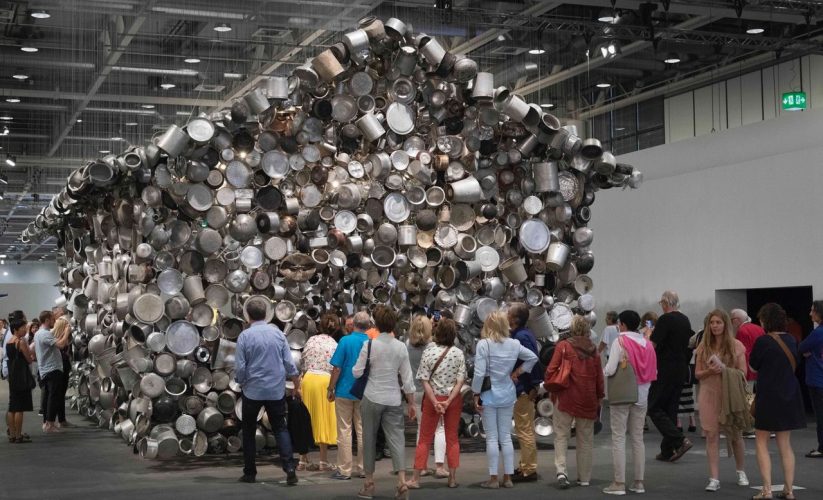
Eating inside a hut made of utensils

Acclaimed artist Subodh Gupta on blurring the boundaries between art, life and community via food
By Rahul Kumar
Objects, especially manmade and mass-produced ones, have unique metaphorical references. For contemporary artist Subodh Gupta, mundane everyday things have deep connotations, even though for most of us their importance is hardly beyond the utility they serve. Gupta, on the other hand, often uses aluminum and steel utensils as a medium to make his sculptures. For him, these used and aged bartan play a particularly crucial role as keeps of memory and record of life they have witnessed.
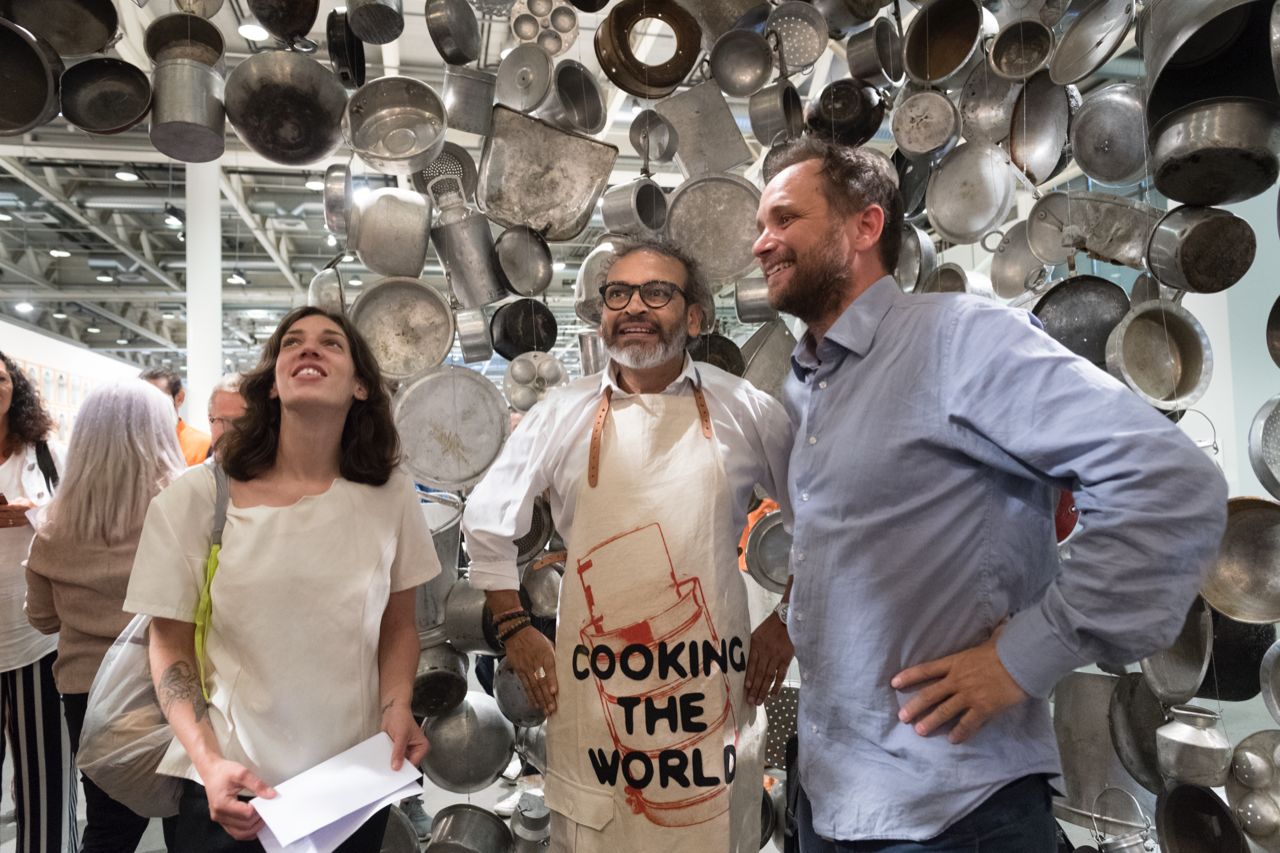
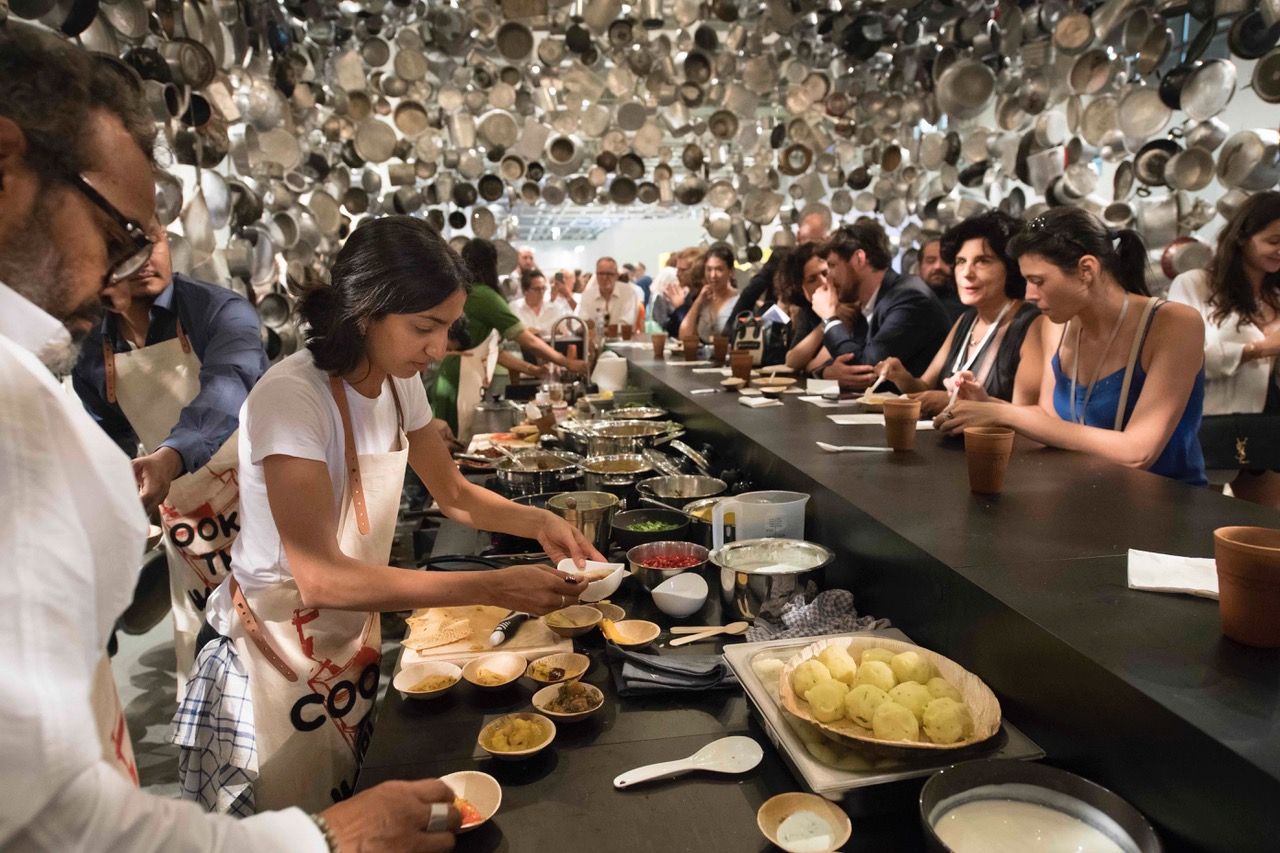
At a recent edition of the Art Basel art fair, Gupta presented an experiential performative piece titled “Cooking up the world”. It aimed at commemorating the ritual of cooking and eating practices. The artist challenged aesthetic traditions of the readymade to showcase ideas of our psychological conditioning, intellectual referencing, and our own emotional associations.
In this interview, we discuss with him his art practice, the journey so far, and food as .
Rahul Kumar (RK): Household objects form an integral part of your repertoire. What is it about them that evokes emotions for you? Is it personal memories or a comment on society, or both?
Subodh Gupta (SG): Household objects, particularly kitchen utensils, are a significant part of my work because they carry personal memories and universal symbolism. Growing up, these everyday items were deeply connected to my family and culture, and they evoke nostalgia for home and the past. However, they also serve as a commentary on society—on the roles these objects play in shaping our lives, the rituals they are part of, and how they represent the intersection of tradition, modernity, and human experience.
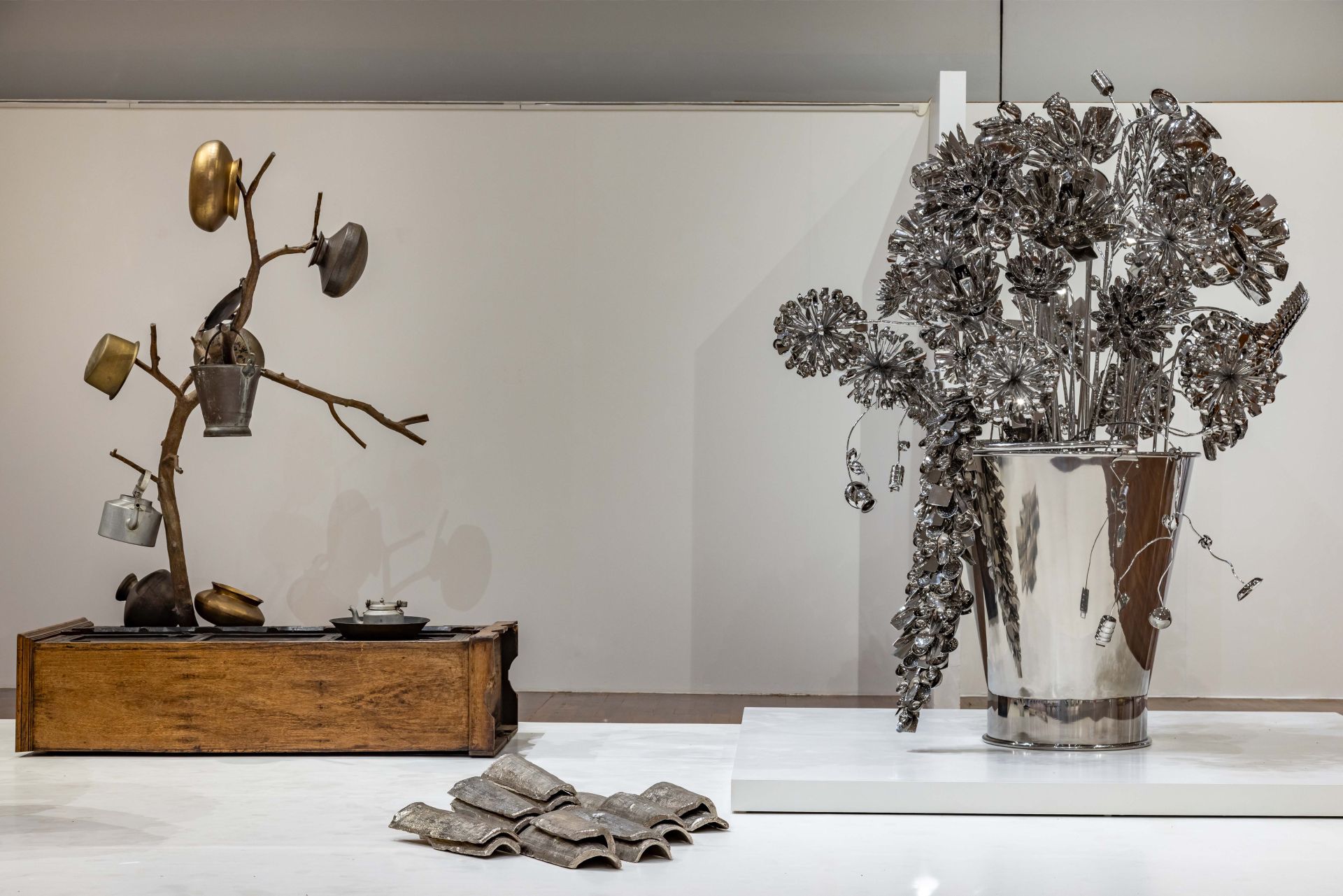
RK: How do the new, shining utensils juxtapose and sit beside old, dented and used ones? What metaphors are to be drawn from both these types that have a recurrence in your sculptors?
SG: The interplay between the new, shining objects and the old and used ones in my sculptures is central to their metaphorical depth. The gleaming ones evoke aspirations, modernity, and transformation, while the worn, aged pieces speak of histories, memories, and the passage of time. Together, they reflect the dualities of life—progress and nostalgia, the mundane and the extraordinary. This recurrence in my work bridges the personal and universal, inviting viewers to consider how everyday materials can embody broader human experiences.
RK: What did it mean for you to bring these objects, in a new form, back to the very land and for people from where it originates for you – Patna? Beyond personal nostalgia, what was the desire with which you took it back for this audience?
SG: Bringing these artworks back to Patna, the place where I grew up at, was a deeply emotional and symbolic act. It was not only about revisiting personal memories but also about offering a new perspective on the everyday items that shaped my upbringing. My ongoing solo show at the Bihar Museum, titled The Way Home, is therefore special. By presenting my work in a transformed, artistic form, I wanted to challenge the local audience to reconsider the significance of these objects—seeing them not just as functional but as powerful symbols that speak to both individual histories and broader cultural narratives.

RK: Your performative intervention of cooking and serving at Art Basel gained a lot of attention. What was the objective of doing this? How are you responding on food preparation and consumption as an act of contemplation?
SG: I have presented the performance at the Basel Art Fair as well as in various locations across Italy and India. The purpose of these performances is to create a space where art, contemporary practices, and food come together, allowing me to channel my passions into an immersive experience. For me, cooking and serving a meal is not merely about nourishment but an act of creation and connection. When I prepare and serve food, I invite the audience to partake in a shared moment of celebration, where they are not passive observers but active participants in the performance. The act of coming together over food becomes a reflective experience—blurring the boundaries between art, life, and community. In this way, we collectively explore the rituals of preparation and consumption, discovering meaning in the seemingly simple yet profoundly significant act of sharing a meal.
RK: Further, how through this act do you challenge aesthetic traditions of the readymade to present novel ideas of referencing and anecdotal assumptions to viewers and enable them to relate to their own associations?
SG: I don’t approach my work with the intention of challenging aesthetic traditions or presenting novel ideas for their own sake. My focus is on creating art and crafting content authentically. Aesthetics, in this context, are subjective and open to interpretation—it is entirely up to the audience to engage with the work in their own way. Through this act, I simply provide a space where viewers can draw their own references and associations, shaped by their personal experiences and perspectives. My role is to create; how the audience chooses to perceive or relate to it is completely their choice.
RK: …and eating inside a hut made of utensils. Why?
SG: Eating inside an artwork installation that I created was a deeply personal experience for me, particularly within the context of Jalsa that you refer to. The installation conveys a message of inclusion and tolerance through food, a universal symbol of togetherness. In India, our dinner table represents family and intimacy, yet our diversity often highlights divisions. By using discarded aluminum pots, pans, and utensils, I aimed to remind people of the shared memories and histories these objects hold. Each utensil tells a story of nourishment and connection, transcending boundaries. Through this work, I invite everyone to reflect on the universality of sharing a meal and the bonds it creates.
RK: Cooking itself has hierarchies. There is the luxury of fine dining and Michelin star chefs. In contrast, it is an everyday chore to feed a family. And then special occasions and festivals require a certain preparation to complete the celebration. How do you unlayered these paradigms?
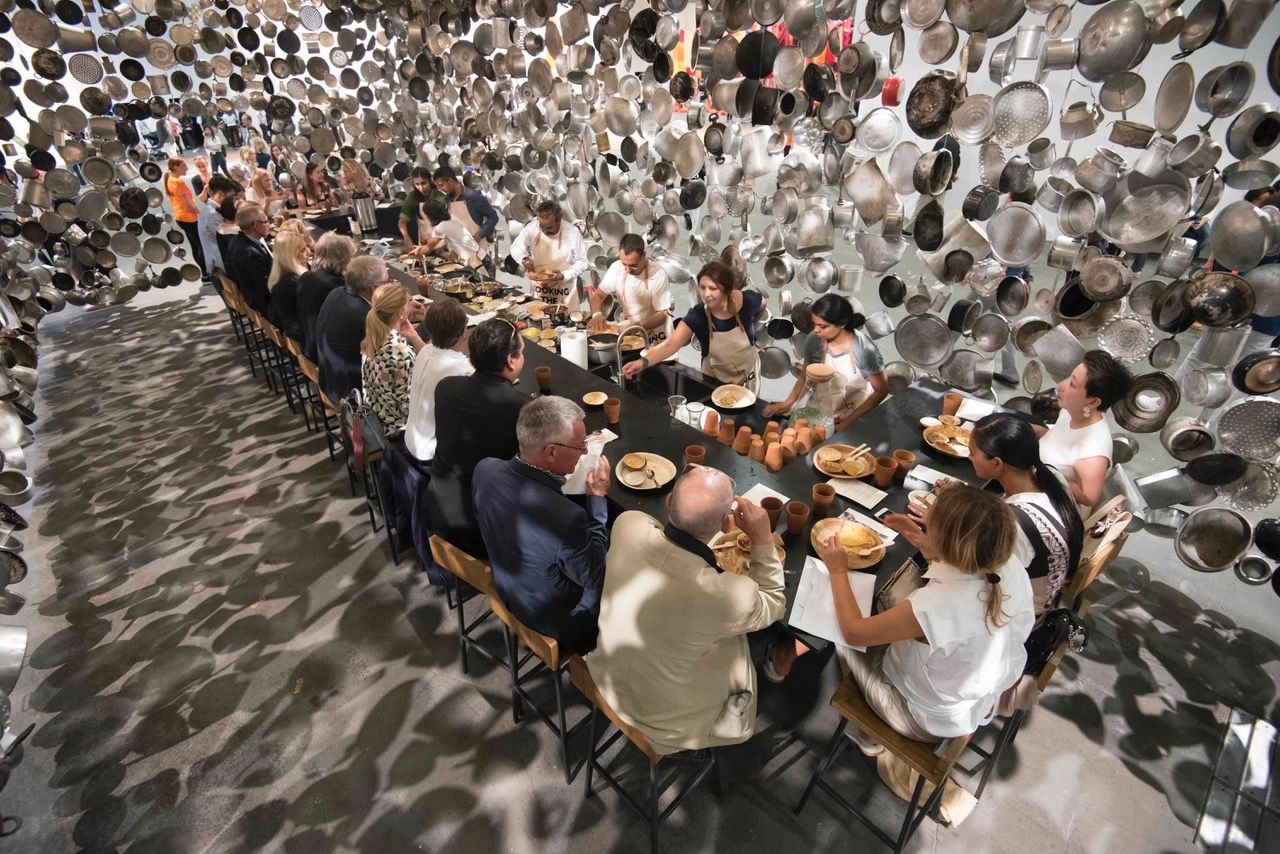
SG: Honestly, I don’t consider these hierarchies when approaching my performances—I simply do what feels natural to me, as I do when creating art. Everyone has their own way of celebrating food. For some, it is tied to festivals such as Diwali or Muharram, while for others, it is a way of expressing happiness at any moment. For me, the act of cooking and sharing food within the context of my performance is about fostering joy and connection with the community. I have great respect for all faiths and traditions, but I neither seek to challenge them nor place rigid expectations upon myself. My approach to cooking is relaxed and instinctive, allowing the experience to unfold freely and inclusively.
RK: Is there politics of food production and consumption that you are particularly interested in exploring?
SG: When it comes to food production and consumption, what concerns me most is the excessive intake of junk food, often driven by marketing and today’s social media trends. In daily life, food is frequently consumed out of necessity rather than with mindfulness, and while some may enjoy it, the lack of attention to its quality is troubling. I firmly believe that food should be organic, natural, and free from chemicals. Pasteurization and over-processing strip food of its authenticity and can contribute to various health issues. My perspective is rooted in advocating for food that nourishes both body and mind, avoiding artificial additives and harmful practices.
RK: In your view, has the idea of food become politicized with factors such as religion and ethnicity to influence it? But you have used it as a tool to bring people together. What has been your experience in doing so?
SG: Food has undoubtedly been politicized in many ways, often shaped by religion, ethnicity, and cultural influences. However, through my art, I endeavor to move beyond these divisions, using food as a medium to bring people together. The everyday objects and rituals associated with food, when reimagined through art, create a shared language that encourages reflection and dialogue across diverse communities. My aim has always been to emphasize that, at its heart, food is about connection—whether it is a connection to our roots or to one another, transcending the societal divides that often surround it.
RK: What next for Subodh?
SG: The Way Home at Bihar Museum is incredibly important to me, but beyond it, I’m focusing on the Uzbekistan Biennale in 2025, which will include both sculpture and performance, curated by Diana Campbell. I’m also looking forward to projects in Paris and Japan—two of my favorite cities—which I’m excited to explore further through my work.