Food as art, beyond aesthetics

Three artists invite us to examine what lies beneath the act of eating. Across contemporary Indian art, food is being reimagined as a lens to examine life itself (even as chefs play with just form)
By Rahul Kumar
Food is often spoken about as comfort, or culture, but in the hands of artists, it becomes something far more complex: a language of memory, power, ecology, and survival. Across contemporary Indian art, the idea of food is being reimagined not merely as sustenance, but as a critical lens through which to examine the social and political conditions that shape everyday life. In conversations with three artists: Rajyashri Goody, Satyanarayana Gavara, and Sujit Mallik, for who food emerges as a deeply layered medium. For one, it is inseparable from the emotional terrain of belonging; for another, it is rooted in hunger, labour, and agrarian inheritance; and for the third, it becomes a living material that connects body, soil, and ecological ethics.
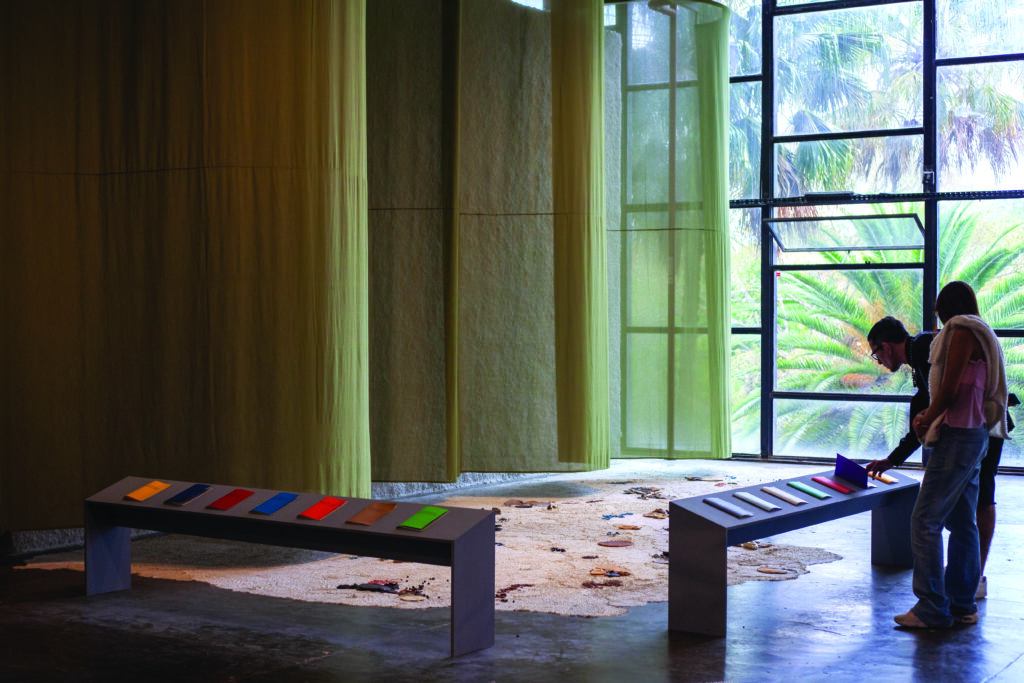
What binds their practices is not a shared aesthetic but a shared urgency to rethink how food shapes us and how we, in turn, shape its meanings. Whether through performance, narrative, or participatory practice, each artist invites us to reconsider what lies beneath the everyday act of eating. In doing so, they transform food into a site of inquiry, one that reveals as much about inequality and memory as it does about nourishment itself. To speak of food is to speak of life. Yet, as these three artists reveal, to speak of food is also to speak of everything that structures life, labour, ecology, memory, and desire. What might appear as a universal, even mundane, human experience becomes, under scrutiny, a deeply uneven terrain.
Cookbooks as privilege
What is striking about Rajyashri Goody’s approach is her refusal to isolate food as a cultural artifact. Instead, she situates it within systems of access and denial. Her interest in cookbooks, for instance, opens up a powerful critique. Cookbooks, she notes, are often taken for granted as repositories of tradition, but they are also products of privilege. The ability to document recipes, to possess diverse ingredients and utensils, and to take pride in one’s culinary heritage are not universally available. For many communities, historically excluded from such access, the absence of cookbooks is telling. “There are very few Dalit cookbooks in existence,” she points out, turning instead to literature of the communities as a source of culinary memory. In her work, food becomes an entry point into an emotional archive: pride, shame, guilt, joy, anxiety, hunger, all circulate through the seemingly simple act of consumption.
Absence as presence
If Goody’s work excavates the socio-political layers embedded in food, Satyanarayana Gavara approaches food through the lens of lived experience, particularly hunger and agrarian struggle. His reflections are grounded in memory, moving between childhood and adulthood, between the home and the field. “My struggles with hunger during my studies echoed my childhood memories,” he recalls, linking his personal experiences to his father’s life as a tenant farmer. The precariousness of cultivating land that one does not own becomes, in his work, a metaphor for broader conditions of marginalization. Gavara’s relationship to food is shaped by absence as much as presence. He describes a childhood where food was not always available, where the desire for something as basic as rice three times a day carried emotional weight. “Food wasn’t always there when I was hungry,” he says, capturing a reality that transforms food from a cultural symbol into a matter of survival. This history informs his artistic practice, in which food becomes a way to reconnect with his roots, not through literal farming, but through what he calls a “surface-level farming of emotions and stories.”
Vegetables as living colours
Between Goody’s structural critique and Gavara’s autobiographical narrative, Sujit Mallik introduces yet another dimension: ecology. For Mallik, food is not merely consumed; it is part of an interconnected system linking the body, the earth, and the environment. “I don’t find any difference between body, earth, and food,” he states, collapsing distinctions between these entities. In his practice, vegetables are not just materials but living colours, substances that enter the body and become invisible, yet remain fundamental.
Mallik’s work often operates through participation and community engagement. His initiative saagwala, for instance, brings together farmers and consumers in a shared commitment to ethical practices.
Food that shapes power, memory and belonging Despite their differing approaches, all three artists converge on a key insight: food is never neutral. It is shaped by and, in turn, shapes systems of power, memory, and belonging. By foregrounding the emotional and social dimensions of food, Goody creates a space where difficult conversations can begin. For Gavara, the pull of food is more visceral. It is tied to memory, desire, and the body’s most basic needs. His recollection of shifting from ragi malt to aspiring for rice is not merely anecdotal; it encapsulates a broader narrative of aspiration and deprivation. Mallik, meanwhile, approaches food as a material and conceptual bridge between humans and nature. His description of grains, vegetables, and fruits as “mineral capsules” highlights the processes through which the earth sustains life. By using raw vegetables in his art, he seeks to reconnect people with these processes and emphasise the importance of ethical production.
Beyond aesthetics
These conceptual explorations find concrete expression in the artists’ works. Goody’s participation in the exhibition Revolutionary Remembrance (2025) in Mahad offers a particularly compelling example. Through a reading performance of recipes and poems, she engaged directly with her audience. What made the experience significant, she notes, was the immediacy of recognition. “They immediately got it,” she recalls, emphasizing that no explanation was necessary.
Gavara’s project Tradition Interaction (2025), staged in Siwan, Bihar, similarly emphasizes engagement and dialogue. By bringing together farmers, landlords, and tenant farmers, the performance explored the changing dynamics of rural agriculture in the context of urban migration. The merging of worship practices from different regions created a space for connection, allowing participants to share their own stories. For Gavara, the success of the work lies not only in audience engagement but also in deepening his own understanding of rural narratives.
Mallik’s Vanishing Spices (2021–22) takes a participatory approach, transforming the act of cooking into a collective exploration of soil, consumption, and ecological awareness. What began as a dinner show evolved into a series of events, each delving deeper into the relationship between food and its sources. By involving participants in processes such as collecting ingredients and cooking, the project sought to ground them, both literally and metaphorically, in the realities of food production. The emphasis on “provocations” reflects Mallik’s intention to disrupt habitual ways of thinking, encouraging participants to reconnect with the “native soil.” Taken together, these works highlight the potential of food as an artistic medium, not merely as a symbol, but as a process, an experience, and a site of interaction.