TFTA Top Restaurants of the year

What if buzz wasn’t on the list?
Where you choose to spend your money and attention should not be driven by a restaurant’s influence, PR and online visibility, but by its excellence. What are the parameters to judge that? Here’s how I evaluate my list
By Anoothi Vishal
>Evolution should be an important criterion while judging restaurants. Which ones have pivoted or grown for the better? After all, success is not static but a process. It also kills two birds with one stone—judging the judges, because only those who have sufficiently studied restaurants and their craft can say what has evolved.
>Exceptionalism is the most important criterion while grading anything. Is it unique? The chef’s talent, his or her authenticity and politics. Many restaurants do derivative well. Many copy global trends—ants in the food, fermentation in areas where fresh ingredients are plenty, and so on. This is wannabe behaviour. Best restaurant must have authenticity, uniqueness and freshness to their ideas. Also, therefore, stylish sushi, pizzas, small plate of something charred, cocktails on every feel-good menu are ruled out here.
>Experience. A sense of place, the over all experience. Is it enjoyable? Does it promote conviviality, a sense of wholesome bonding we have lost as a society, discovery and indulgence? I refuse to look at spaces that by virtue of their design, and strategy cater to only 12-16 FOMO-fed foodies. A reservation should not be competitive sport. Restaurants that work on collabs and sponsorships are events. The world over, chefs themselves are questioning these very small, expensive, exclusivity restaurants. I couldn’t agree more with Marco Pierre White when he says these uber small, over composed, precious plates via assembly lines are about the chef, not the diners.
>Cultural context, but no excessive narrative as the raison d etre. A chef should have a deep personal association with the food s(he) is cooking. But when that is genuine, it is felt in the room. For social, political, historic discourse that chefs are no experts in, we’d rather read books by political and social scientists or historians (or watch those podcast).
Here’s my list of restaurants that I think are the best in India —which I would recco, in this particular order.
You’ll notice some notable omissions; I have explained the reasons above. Papa’s: I think Husain Shazad is one of the most talented chefs of his generation. But I’d rather go by his food at The Bombay Canteen, which is more accessible and inclusive. People who struggle for one restaurant reservation ought to employ their time better; it just promotes a cult of exclusivity where dining becomes a status symbol, something I abhor. Naar: I have praised Prateek’s work in long articles elsewhere, but having eaten the dishes he serves at Naar, at his pop-ups, I find individual elements to be clever but many do not come together well at all as a plate. I also find the pitch a bit suspect. How is Himalayan cuisine being represented here? That is a very tall claim to make. First, ingredients don’t make a cuisine. Second, the Himalayas are not Scandinavia and the Redzepi universe. They are a huge geography with many different micro cuisines, with deep mythologies, philosophies, practices, and cultures. I see little to nothing of that on the plates which are quite international.
As for this list, it is a snapshot and a grading of the best Indian food in India, imo, of some global food executed exceptionally well but with a sense of place. Restaurants which are similar to (better) predecessors in other cities have been left out naturally—bringing some much needed rationalisation, which is not possible when different people in different cities rank restaurants without eating across India or following restaurants for long periods. I have compared the relatively new with the established old, and ranked these by evolution, and how people choose between restaurants. Old icons that have retained their relevance and are still exceptional or unique find a spot on the list. And obviously, while much great food exists everywhere in India, this is about great restaurants!
In short, these are the places I’d go to and send you to, in this order.
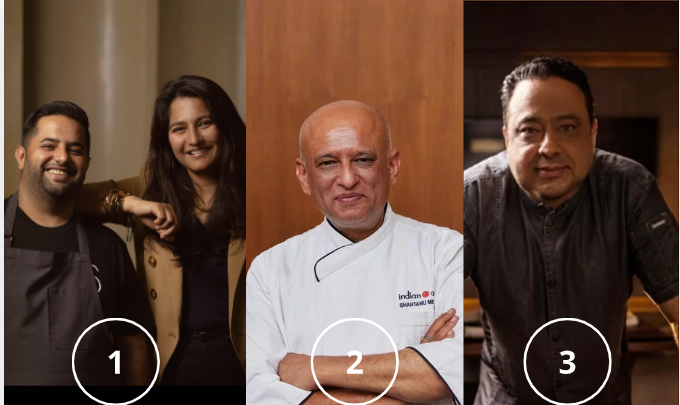
- Masque, Mumbai: The hospitality is uber luxe without it being stuffy. The wine list is full of hidden gems—instead of show-offy suspects. There is a deep respect for Indian ingredients but the cooking has evolved to be far more than just lesser-known flora and such. Instead, chef Varun Totlani is maturing to becoming the finest chef in the country — his plates now marry sophistication with a sense of roots that feels personal and therefore authentic. The new menu has a stellar dish which exemplifies this new approach. I was smitten with the inspiration and construction of the Bombil papad with a crab seaweed “pickle”, which is one of the courses in the current degustation menu. To take something completely local, tie it in with your family’s Sindhi heritage (papad-achar) and execute it with svelte internationalism is also a pean to Mumbai’s cosmo-chicness. I hope this strand of thinking and cooking continues at Masque, a rare enjoyable-yet-serious restaurant.
- Indian Accent New Delhi: Most food writers and commentators will wake up to this hopefully soon, but Delhi’s discerning diners (who do exist!) have all been talking about Shantanu Mehrotra! I have been hearing from many people how they have had their best ever Indian Accent experience with Shantanu’s menu! This is saying a lot. But I ratify this sentiment because I felt exactly the same when I dined at the restaurant a few months ago. This perhaps has to do with how we ourselves have evolved as diners. The food is lighter, more delicate and less in-your-face with spicing. But what I love is how he is moving away from bold street food flavours to subtler home cooking; treating this as inspiration for layering, combinations and presentations. This is absolutely the right direction to take. Indians are eager to taste deeply nuanced Indian cuisines. The way the experience is structured is also very enjoyable — a rarified atmosphere of courtesies and charm.
- Nisaba New Delhi: I have been an early supporter of the Manish Mehrotra school of cooking since even before Indian Accent opened at the Manor in 2008 or so. The way he can deepen the taste of anything and intuitively understand combinations in which many Indian foods are eaten is unparalleled. Manish doesn’t need my ratification. Many of Nisaba’s dishes are addictive because he has gone inwards to better well-loved classics from different regions, street and commercial icons of different towns, in all their punchy glory.
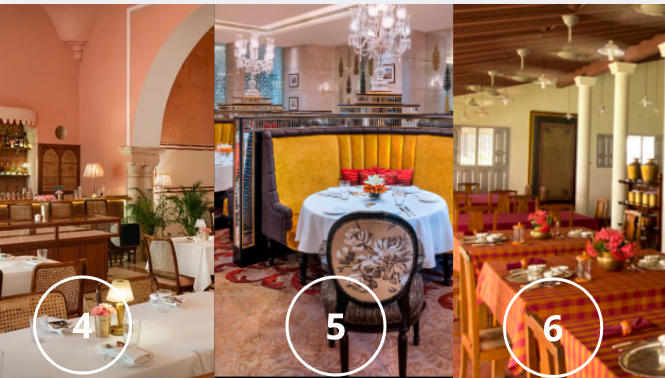
- The Johri Jaipur: I was blown away by chef Sonu’s cooking at The Johri, when I visited it a few months ago, and it is a surprise why he isn’t on any best chef mentions. The all-vegetarian food is glorious, clever with detailing and layering and yet shows how deeply the nuance, spicing and techniques of many Indian dishes are understood. I found I wanted to eat everything on the menu! Sonu created some Rajasthani inspired plates for me —and the way he used difficult to master quintessential regional dishes like chakki ki subzi, and combined textures and tastes is unparalleled. It shows so much understanding of local cooking and an assuredness when presenting these in cosmopolitan ways. It also reflects The Johri’s over all ethos and appeal. A deep sense of heritage but lightened and made modern. In winter, I would also go to The Sarvato by the same group, based on royal Jaipur recipes but for our age and time!
- The Sahib Room, Mumbai: Chef Taj is another one of those quiet master chefs that the current blitz of PR and influencer content overlooks. His Avadhi food is a class apart in particular. The restaurant, after its makeover, is gorgeous, with a fantastic bar and sense of quiet luxury in sync with the old world cuisine it plates up. Taj’s refined cooking and his grasp on the now increasingly forgotten techniques of Avadhi bread making, barbecuing and the lavish, layered and intricate qorma-style braises is a shock in a city like Mumbai. A good one.
- The Bangala, Karaikudi: Everyone who think that destination dining is the next big thing they must subscribe to, please make a trip to The Bangala, which is the best example for how cuisine as part of a region’s cultural heritage can be preserved, kept alive and shared. You get excellent taste, and an understanding of the world of the Chettiyars, India’s most famous trading community with influence in south-east Asia.
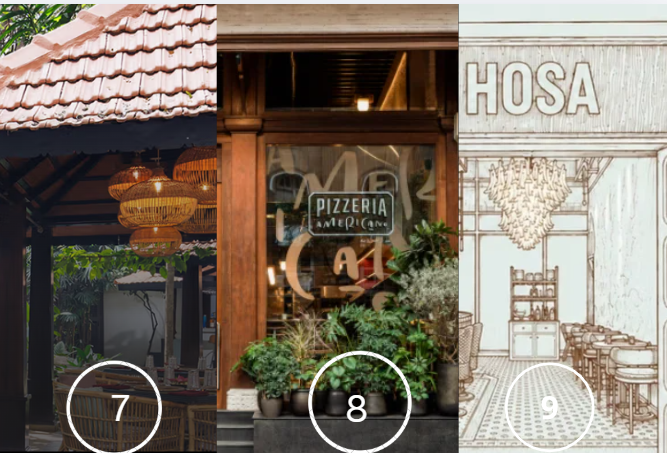
- Karavalli, Bangalore: Of all the OGs, really a lost generation of India’s great chefs who came before social media fame and sponsor deals, the understated Naren Thimmaiah is the brightest gem. He has kept Karavalli relevant to diners seeking authenticity, great taste, and even wellness! The scrupulous research and the beautiful setting makes this a must on any Bangalore, and India, itinerary.
- Americano, Mumbai: The Maximum City’s most fun, high quality diner that brings a bit of chic-casual California in a world where tech bros are now sus! It is so high on my list because of a sense of place. Mumbai is India’s most globalised city and Americano fittingly reflects that vibe.
- Hosa, Hyderabad: Chef Harish is a bit of a genius, who deeply understands southern Indian flavours and has brought these to the fore without tampering with their essence, and yet elevating them with some improvisations and skilful cooking. Pineapple menaskai that suddenly finds itself popular on many Indian restaurant menus within the country and internationally receives its best and most knowledgeable treatment at Hosa. The tender coconut fry, done here like a “65” uplifts two different street snacks in one dish. Harish serves this with a light coconut lime foam that is unputdownable. Of all the outlets, I think, Hosa in Hyderabad, the newest, is the best yet. There are many Andhra dishes which are true to taste, cooked with modern techniques that improve outcomes and presented chic-ly. The way Harish does chepala pulusu, for instance, in a paper boat/envelope like the French en papillote (in envelope), where fish is baked sealed in a pouch, while still retaining the soul of the Telangana dish is modern Indian bistronomy at its best. This is the future of Indian restaurant dining that is not show-offy and boring but viable and top class.
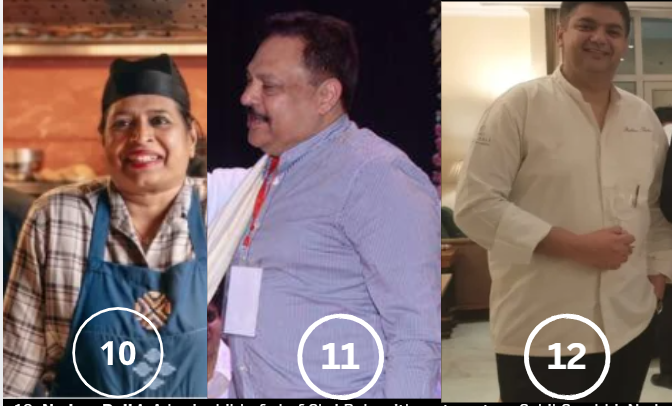
- Nadoo, Delhi: A brainchild of chef Shri Bala with restaurateur Sahil Sambhi, Nadoo is a rare polished restaurant where the care evident in the best home-style cooking is scrupulously maintained even as the dish and environ is restaurant-y. The sourcing of ingredients—from ghee to the meats and spices —is spot on, taking care of regional provenance that contributes to distinctive taste, and the cooking is done lightly, with detailing that Shri Bala, not a trained chef, but accountant-turned-researcher excels at. What makes this whole affair deft, assured and upscale as a restaurant experience is also the team led by Harangand Singh, a very talented chef with an instinct for deep flavours, who assists Shri Bala with technical precision and operational skill.
- Dumpukht, Delhi: There are many younger chefs and home chefs who are now doing different versions and aspects of Avadhi food. But historic Nawabi cuisine was led by highly paid professional chefs whose skill and art took this cuisine to unparalleled heights, making this the most sophisticated in Asia. Chef Ghulam Quereshi is the last of those master chefs, with a depth of knowledge and cultural immersion impossible to emulate. The kakori have never been bettered. But go to the Delhi restaurant only, and when chef Ghulam is around.
- Megu, Delhi: A grossly underappreciated restaurant that hasn’t got its due on the lists, possibly because it is expensive and not enough people who are insiders on the food circuit have eaten here. I have watched it evolve over the years. Chef Shubham Thakur has mastered the restraint and precision required for top class Japanese food, and has a deep understanding of Japanese culture. The ingredients are uncompromised, simplicity maintained and the restaurant experience calm and luxurious.
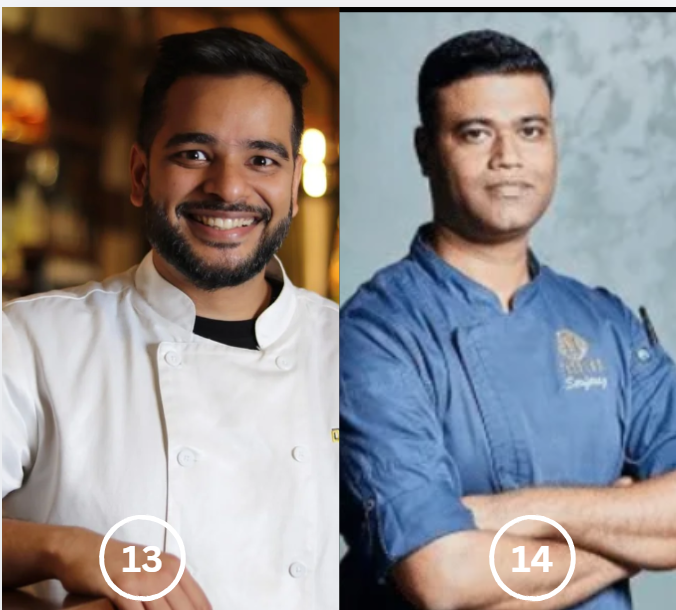
- The Bombay Canteen (Mumbai), Comorin (Gurgaon and Mumbai): TBC (opened in 2016), O Pedro (in 2017) and Comorin (in 2018 in Gurgaon) are really part of one moment in Indian restaurantscape when regional Indian food started becoming chic, casual and café-ised. They all take off from the Indian Accent moment, and then Zorawar Kalra’s Farzi café, which democratised improvisations in “modern” Indian.
- Tres Ind, Mumbai: Its Dubai counterpart has won many accolades, but this one under the watch of chef Sarfaraz Ahmad is excellent too in terms of its food. I am not a fan of long tasting menus, but Sarfaraz’s is flawless— with an understanding of Indian cooking, skilfully executed.
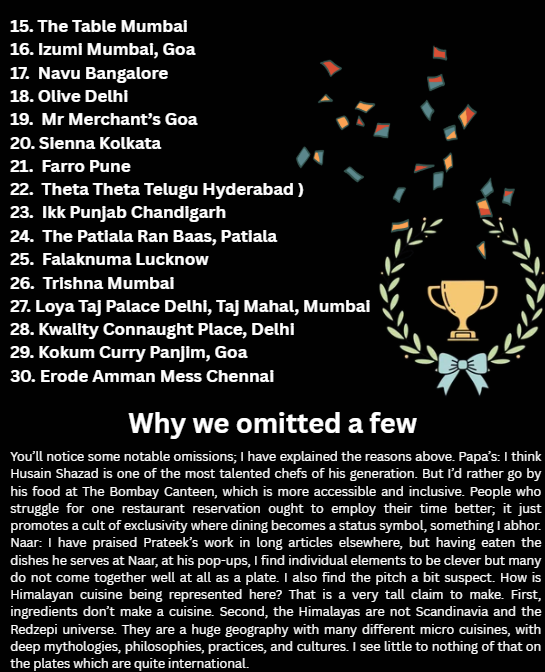
And, 15-30
- The Table Mumbai
- Izumi Mumbai, Goa
- Navu Bangalore
- Olive Delhi
- Mr Merchant’s Goa
- Sienna Kolkata
- Farro Pune
- Theta Theta Telugu Hyderabad (I recco its parent The Spicy Venu for an exceptional Andhra meal and find that food heads and shoulder above any other local meal in Hyd)
- Ikk Punjab Chandigarh
- The Patiala Ran Baas, Patiala
- Falaknuma Lucknow
- Trishna Mumbai
- Loya Taj Palace Delhi, Taj Mahal Mumbai
- Kwality Connaught Place, Delhi
- Kokum Curry Panjim, Goa
- Erode Amman Mess Chennai