Food is How India Speaks

 Industrialist, patron of the arts and co-author of a unique book on restaurants, Sunil Kant Munjal on Punjabiyat, more than butter chicken in Ludhiana, Indian restaurants in Japan, evolution of Delhi’s dining, and his engagement with food at all levels—from restaurants to culinary as an important art form.
By Anoothi Vishal
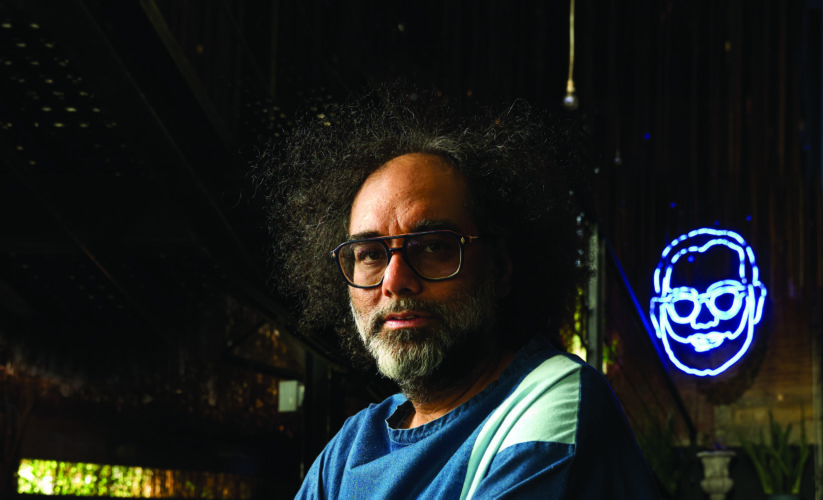
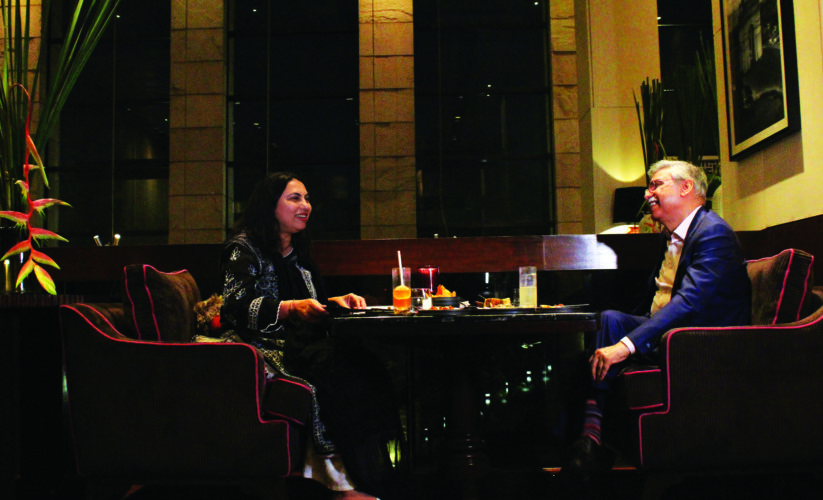
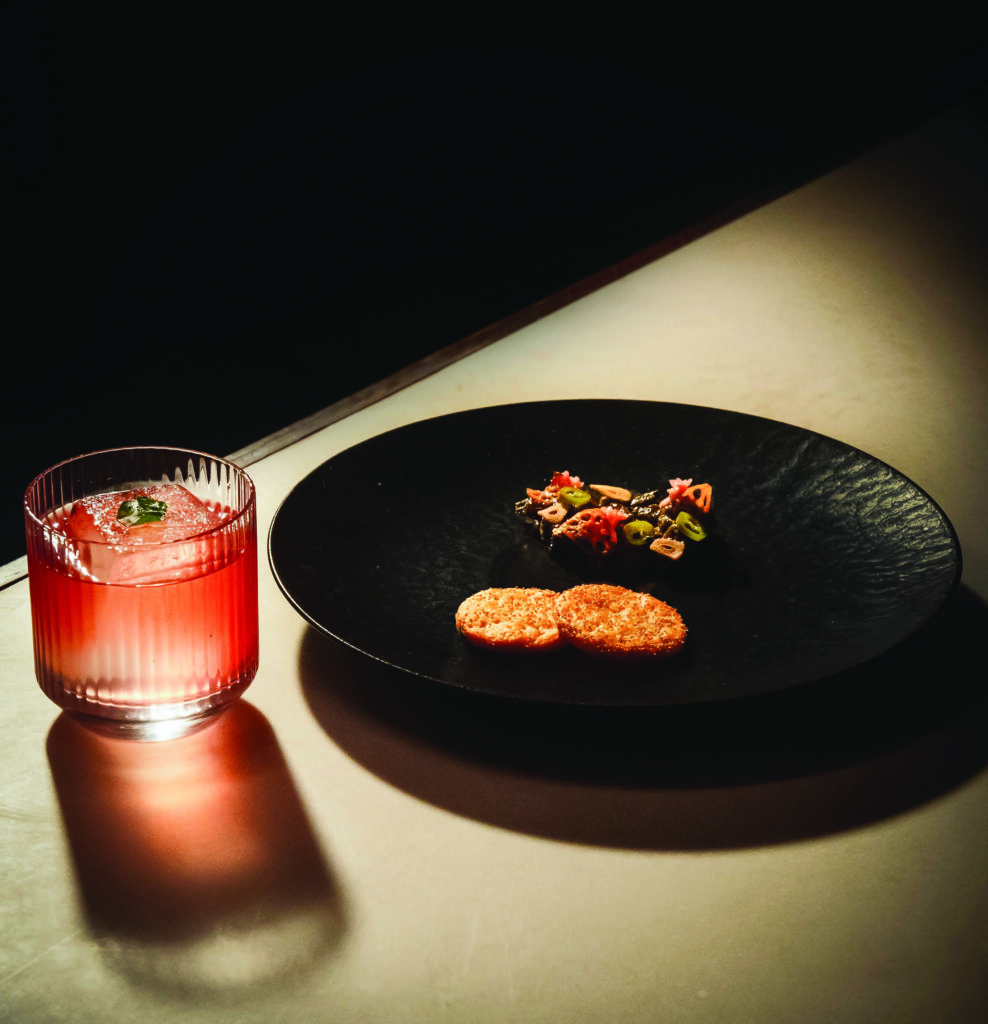
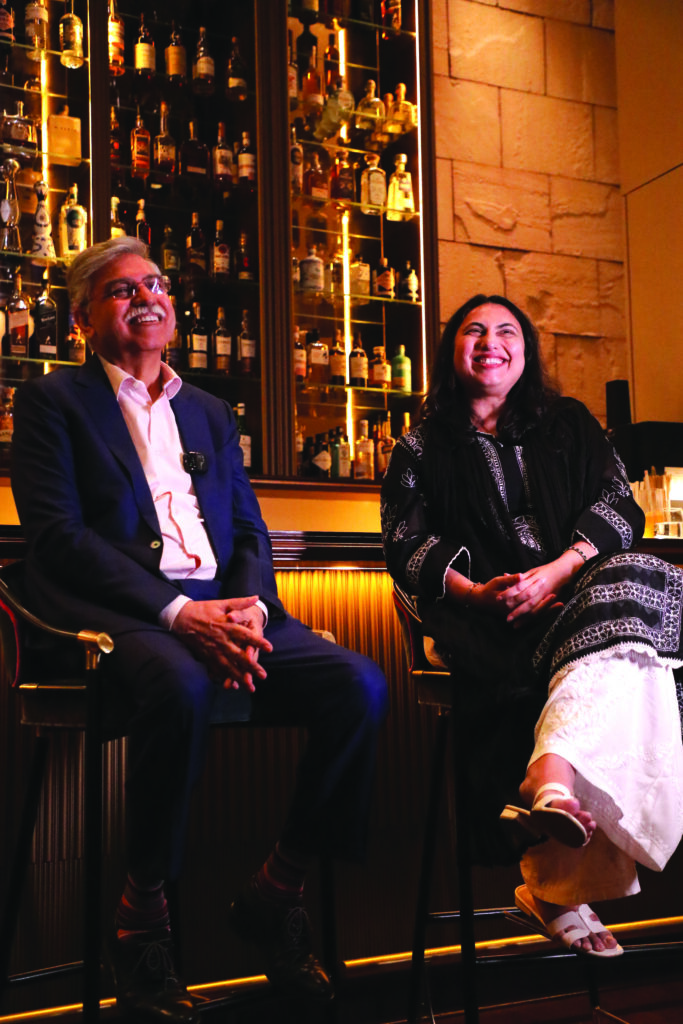
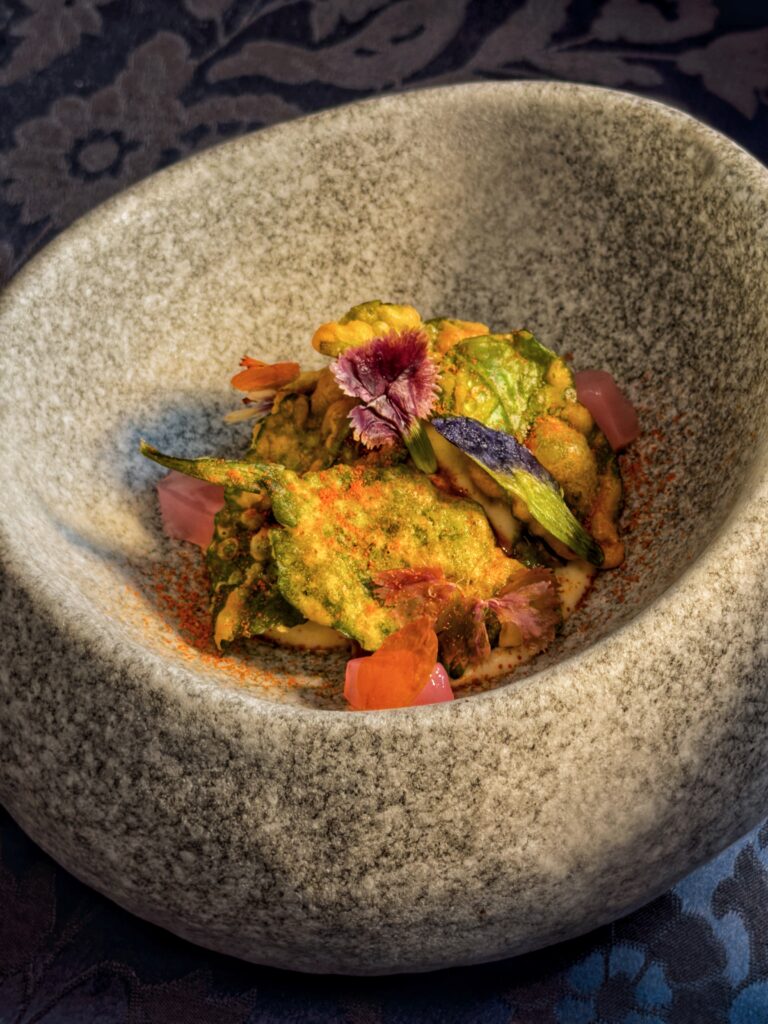
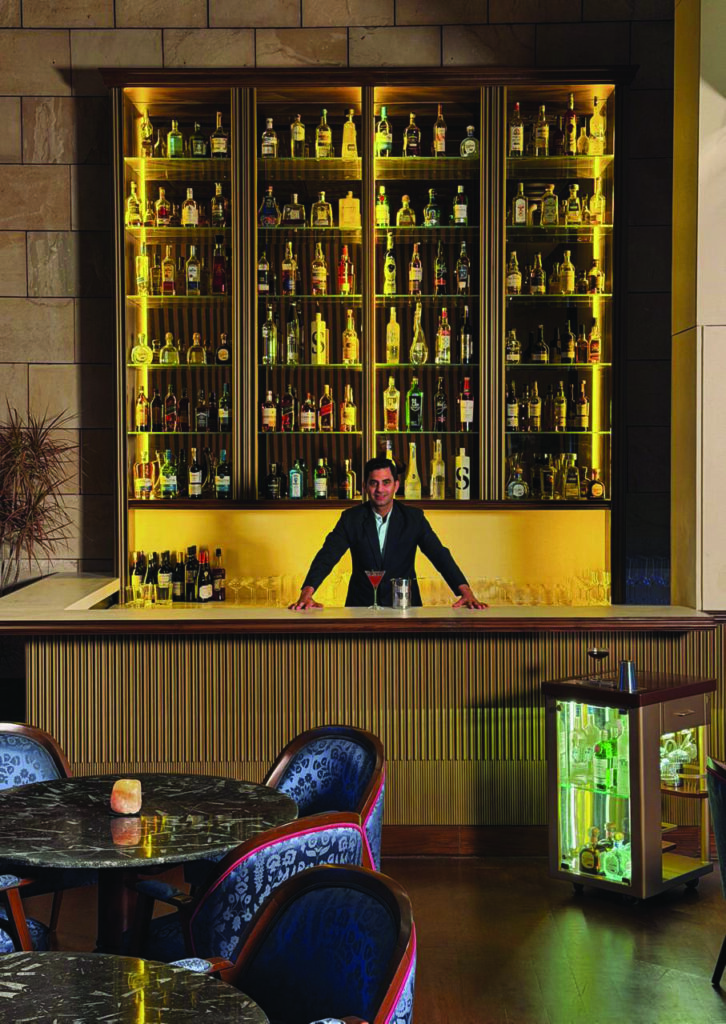
It’s sharp at 6 pm, when Sunil Kant Munjal, chairman Hero Enterprise, India’s leading industrialist, patron of the arts and author of a new, unique book on restaurants, walks up the stairs at Upstairs At Indian Accent, a stylish new members-only bar at the famous modern Indian restaurant in the heart of Delhi. As cameras get adjusted to catch the best light at dusk and the team of chefs led by the young Hitesh Lohat bustles around, bringing to the table small plates inspired by Delhi’s street eats —layered karari aloo tikki resembling the mille- feuille, mini tacoesque kebab-paratha (veg, for our guest)– we get straight into our conversation: intended to be as much food for thought as about food itself. “Ever since the book has come out, I can’t tell you how many messages I have got asking us (the authors, Mr Munjal and his friends Nitan Kapoor and Ajay Shriram) to have a few meals in Mumbai and Bangalore and such,” he says. To which, I naturally quip, “so, are you turning a restaurant reviewer now?”
“Looks like it!”, he laughs.
From Punjabiyat to the cosmo
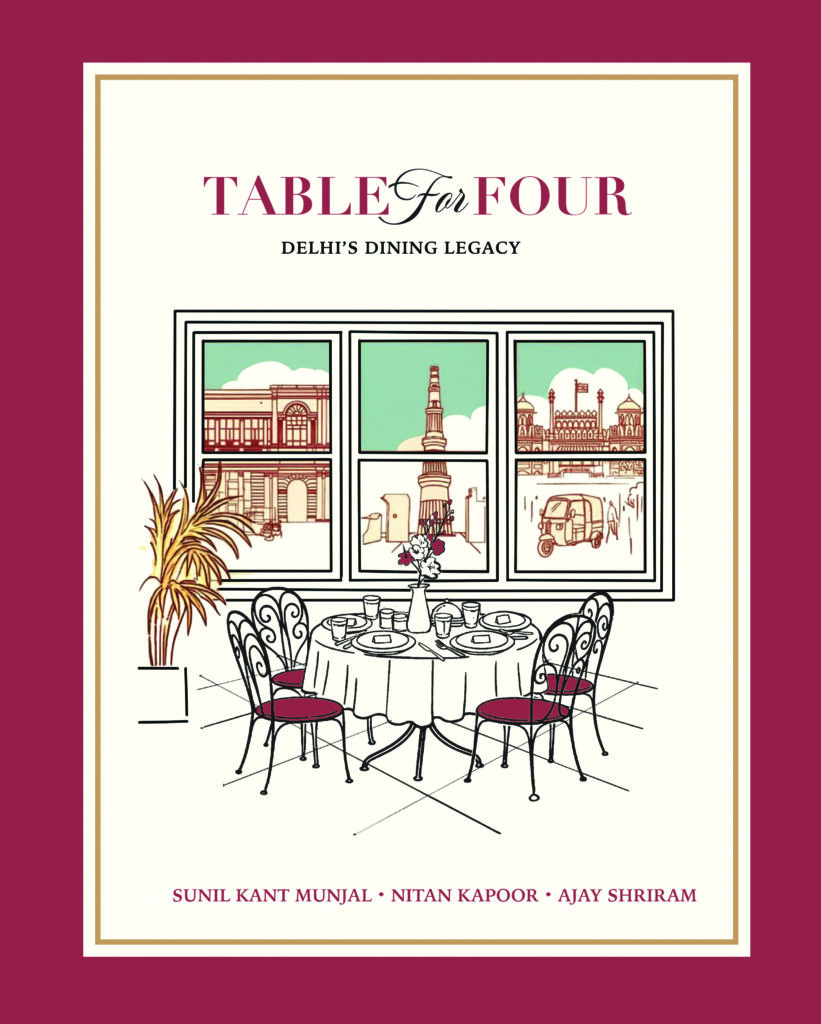
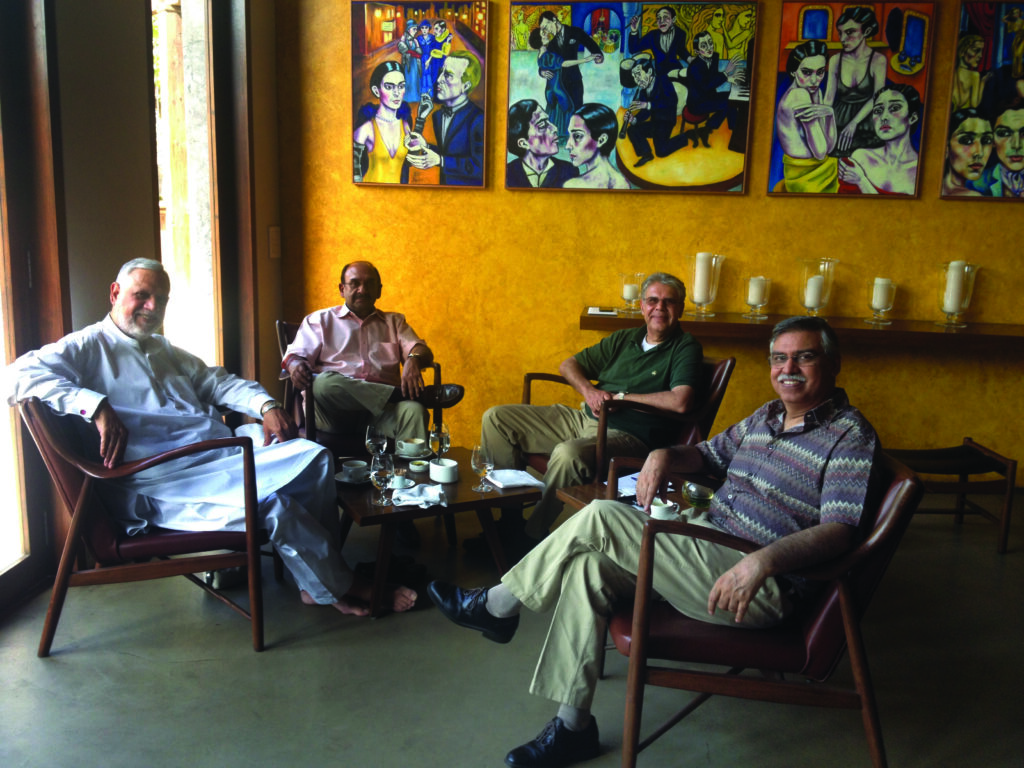
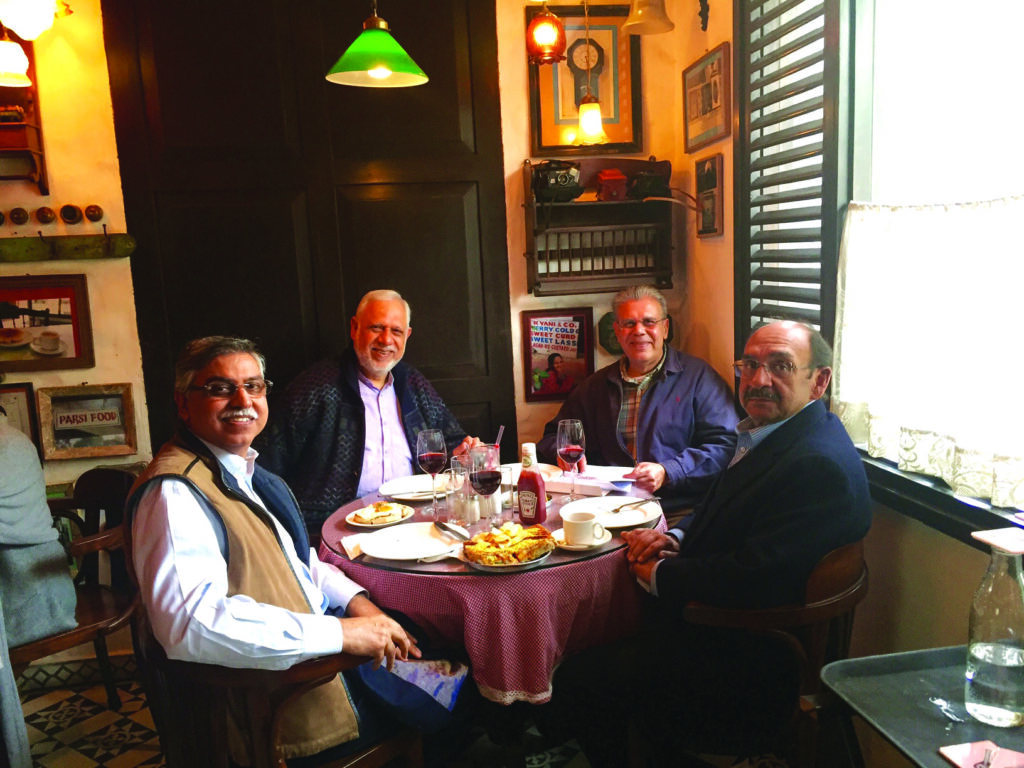
Table For Four is unique; capturing as it does the conversations and restaurant reviews of four friends, all Doon School alumni, over a period of 15 plus years and 75 plus restaurants.
These excursions begin innocently enough— as a means to get together. But it is remarkable that each is meticulously recorded; dishes, service and even the loos (“if the loo is not clean you can actually be almost certain that the kitchen is not super clean.”) at each restaurant are checked and rated in the manner of secret Michelin inspectors.
The reviews were initially perhaps meant as a private idiosyncrasy. None of the authors imagined this would be a book one day. But as the records of their meets-and-eats grew, and after the passing of Deepak Nirula, iconic restaurateur and one of the original four, the protagonists decided to turn this into a book. They approached me, after some trials and errors with others, to help put it together, supplementing reviews with information and pieces around food.
And thus I was first introduced to Mr Munjal just about a year ago, just as I was launching this magazine. It would become a project that would envelope almost all significant voices of chefs, restaurateurs, bar mavericks and yours truly as a food historian, who had shaped the evolution of Delhi’s dining culture. TFF is a book unlike any other in the entirety of India’s restaurant history: Food is the prism through which we see how society and tastes change, restaurant respond, and ambitions grow to today’s boom in dining as lifestyle and business.
“You know, Delhi, earlier was essentially just Punjabi culture”, says Sunil Kant Munjal at one point in our conversation, “it’s become much more cosmopolitan now” but till about three-four decades ago, “even if you came from Bengal or anywhere else, you had to learn Punjabi to communicate”.
We’ve been discussing Punjabiyat and its contribution to business —and food— post Partition. Has the way of doing business here been more personal, family-led? “It’s interesting you should say business”, he tells me, “in Bombay for example, it has been more organised, mechanical and more responsive.
Here, if somebody gave you the time to meet at four o’ clock, they may end up arriving at 5 pm. That would not happen in Mumbai or Chennai, they were more professional. But interestingly, this (Delhi) has been a harder working place. There is a culture of family and friends, I guess, partially because of the displacement (of partition). You want to make friends, you become much closer to people and can do business with strangers and make friends with them quite easily,” he analyses.
We agree that contrary to what people believe north Indian Punjabiyat is more accepting of others—even if, as Mr Munjal warns, sometimes you tend to get misunderstood as rude because it is so loud! “I remember a cousin of mine, she’s sadly passed away now, who used to live in Ahmedabad. She had a landlady living on the upper floor. When her (the cousins’s) sister went to visit her during the holidays, the landlady told her one day, ‘neeta bhen, tumhari sister aayi hai, tumhara jagda hai kya aapas mein?’” She was taken aback, and said no, only to realise that the sisters had been talking in Punjabi!
Loud or not, friendships in this culture endure. Mr Munjal tells me he has never let any friends go. “I am still friends with six people from class 1 at my school then, the Sacred Heart Convent in Ludhiana,” he says. These are ties that keep taking him back to Ludhiana, a home town for not just the Munjals, but also a surprising many of India’s biggest business families.
What is it about Ludhiana that made for top- class industrialists?
“My uncle used to say there’s something in the water.” It was such a small town at the time of Independence that even trains didn’t stop there. Most enterprise came from
migrants, the refugees and like refugees all over the world, I guess, they worked harder. They had a point to prove to themselves and provide for their families. And also, I think, it was a bit cultural and competitive… because Punjabis have this style of wanting to show people even more than they actually have!” They work hard and play hard.
But, in the 70s and 80s, in a milieu where wealth was frowned upon, it is a fact that many families only really struck big when they moved out of Ludhiana, that remains a hub of small industry (and has the largest concentration of bicycle parts in the world, that Hero helped develop, making 90-95 per cent of these globally.
In 1995, soon after the economic liberalisation was to change this mindset and inspire more middle-class ambition, Pankaj Mishra’s Butter Chicken in Ludhiana became the quintessential travelogue tracing the change. Butter chicken became a metaphor. While today’s insta foodies may talk of Baba, Mr Munjal reels off unheard of reccos. A guy who makes only raita. “It is like an ice cream parlour for raitas”. Then, there is Punnu, who makes paneer pakoda, so huge that he spills out of the rickshaw, and is unable to turn to the side, so he asks buyers to come in front before dishing out the plate! Then, there is Sir Mayaram selling teetar-bater (partridge and quail, regarded as delicacies). Why “Sir”? Ostensibly, it is a self-bestowed title “may be because he is so good”!
Food is how India speaks
We laugh at the anecdotes, but there is a seriousness that Mr Munjal accords to food— whether as something cultural (at Serendipity Arts Festival, in its 10th year now, culinary arts is as important as visual and performing), as a consumer-facing business (he is an investor in Rohit Khattar’s EHV International and says that though it began as a “fun investment” he is impressed with the way “Rohit has done a phenomenal job in growing the business as also almost restructuring it in the way a variety of new brands are opening… Each time, he is able to open a completely different restaurant and get customers coming in. And turn the business profitable.”) or even in terms of policy and food security (he is known to informally advise governments and ministers as an industry leader). Despite these engagements, Mr Munjal is often thought of as being “not a foodie”.
He refutes this. His preference for no chillies and vegetarianism aside, he enjoy all sorts of food experiences. Apart from Dubai, London and Paris, the big restaurant cities, he is partial to “smaller, not so well known places that are unexpected… the small towns and villages in Italy, Spain and Greece, I am a foodie of that kind.” Of his unexpected finds, he says, there is a Spanish gelato shop,
that has been awarded as the best in the world, “you’d never imagine that.” And the best tiramisu he has had has been in France, not Florence. “So, I am a global expert on tiramisu”, he laughs. “Sometimes you find things you least expect, and that tells you a little bit about the world”.
The foods of his memory are equally the small, homely treats: cold coffee his chachiji was renowned for (“we grew up in two houses with a large courtyard no walls, and two kitchens so, it didn’t matter which one you ate in.”) or the papad-wadi-chawal that was his mom’s specialty. His mother-in-law, on the other
hand, was an expert in “exotic western food”, and his late wife “an expert of banana cakes and carrot cakes” and new dishes she would experiment with and serve to guests with warmth and flair. She loved Japanese food too.
“I’ll give you one interesting fact about Japan. In the very early days, when conversations for what became Hero Honda were going on, in Tokyo, there were literally two-and-a half Indian restaurants. Now, there are over 250. The people who are eating there mostly are young Japanese. It’s fascinating to see them. Japanese food is quite bland as you know. These people always have their handkerchiefs out, because they are sweating away with all our mirchi and spices they are unaccustomed to!”
Japan’s fascination with India and Indian food is because
of its investments in the Indian economy, Mr Munjal adds. “India is a place they find where they’re not unwelcome and there is potential to invest and keep growing for the next 30 years. You can’t say that about too many countries.
If they’re going to invest here, they’re of course going to send people. And the more people come here, the more they go back home and speak about India’s variety in food, the spiciness… Food is part of our communication.”
In Table For Four, a communication is also around the democratic eating out choices of four affluent friends. From chaat at Bikanervala to Andhra Bhavan (that didn’t make it to the final cut in the book), all are experiences that Mr Munjal and his friends prize. “We were going in all humility, saying we are going to just enjoy the afternoon,” he points out. They may not have realised it but they were chronicling the evolution of Delhi’s dining culture and social changes.
From when they began to now, the behaviour of diners has obviously changed, especially post covid. “The interactions, behaviour and ability of socialise have all become more mature, but they have got more compartmentalised too”, Mr Munjal assesses. “I think, covid contributed to this, people started to coalesce in groups, and some of these were huddles of only one type of people rather than people from different backgrounds.” On the other hand, people have lost formality, they are more at ease, the clothes are more relaxed, and people perhaps don’t care so much about being “seen” in the right places. “It is a maturing of the social system. Don’t forget, we are only one generation away from the generation that went through this rough Partition.”
So what is it in a restaurant that attracts a discerning diner? “It’s more than food, it is about the attention you get, how restaurants make you feel,” he promptly answers, and cites the example of Andhra Bhavan, where the wait staff the authors encountered was no less than a French maitre d’ of a top restaurant. Despite wanting to turn tables quickly, “he guided us on our order, and then came back to check on how the food was and returned three or four times through the meal to help us tweak our order depending on what we enjoyed… this is not something you find often in Indian restaurants though to be fair it is now becoming more common.”
The Brij in the making
Those who have been to the Serendipity Arts Festival in Goa will know of Mr Munjal’s deeper preoccupation with food – for the social and cultural impact it has on our lives. “In India, right from when a baby is born, to when a baby walks, to when a baby gets teeth, to every festival, you distribute something different, chana, or halwa, seviyan, laddoos, and everything has a meaning. There’s a historical perspective of how and where each food came from. We want to invest in, push and investigate this … we are trying to connect our past to our present and look at where we’re going in the future.” He says, pointing out various projects on proteins (insects and bugs as a source), on the history of the humble brinjal, ghee and feni and practices like perfumery in food.
With The Brij, his most ambitious project yet, set
to come up in 2028-29, he will push the scope of this engagement further. A campus, built over 1.5 million square feet, envisages 20 institutions that will allow you to experience every art form within one single campus. “We consider the culinary arts as important as the performing arts, visual, design. All of them can be equally life- changing. So, we are putting in food labs, restaurants and everything in between. There will be a variety of offerings, right from children coming in and cooking because we are also creating a children’s museum, to people being able to do literally everything — skilling, training, education, innovation, research and practice.” And Delhi’s first public library since Partition (!) is part of the plan.
Desserts have arrived at the table. There’s white chocolate peda, truffle kheer and an interesting saunf-mishri candy floss. “That’s Buddhi Maa Ka Chata in Punjabi,” Mr Munjal laughs, before taking out notes for his speech at a business school event he’ll be off to this evening.