FINDING HOME STYLE AVADHI

Beyond the biryani, lies a far more vibrant
world of Avadh’s diverse community cuisines.
From keema lal mirch to kofte ka salan and
shakarkandi kheer, Samir Kuckreja, Founder &
CEO of Tasanaya Hospitality, discovers a taste for dishes once cooked only at home, via a
unique Qaiserbagh restaurant, and a cultural
fest sans the brouhaha! By Samir Kuckreja
I have been visiting Lucknow regularly for 40 years – initially to see my parents who lived there, and later to visit my sister, Madhavi, who moved there over 20 years ago. So, you can say I have had a close connection with
this charming city, its diverse people, and its incredible food.
But Lucknowi food and culture go beyond their pervasive cliches we encounter all around, especially on social media, in the age of gastro tourism reigning supreme.Much of Avadh’s fabled Ganga Jamuni tehzeeb and cuisine is now confined to homes, and you may need to know a few old-timers and families still keeping home-style traditional cooking alive across communities to be able to get a taste of this. It’s not merely about the galawat ke kebab, chai, chaat and biryani!
Some of the dishes and recipes of this
local cuisine of the erstwhile Avadh are
being protected and revived via initiatives
such as The Mahindra Sanatkada Festival,
of which my sister Madhvi is the Founder,
and an under-the-radar restaurant that I
keep going back to called Naimat Khana
located in Qaiserbagh, Lucknow, in a home.
Conceptualised by Askari Naqvi in 2019,
with dishes curated by Sheeba Iqbal, this
restaurant has a unique concept because half
FINDING
HOME
STYLE
AVADHI
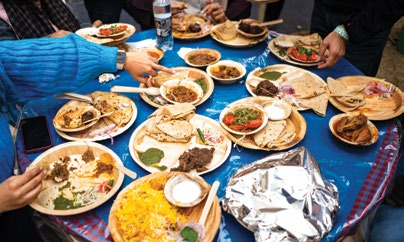
the dishes on the menu are always prepared by home cooks
in Lucknow. The other half are made in house! This gives
customers a rare opportunity to “eat the best dishes served in
Lucknow homes”, as Sheeba told me when I interviewed her
for this article. She describes the menu as a true representation
of Avadhi food in all its diversity, featuring specials such as,
“Kebab from Anju, Korma from Sundar, Nirmala’s Khatta
Meetha Karela, and Farzana’s Dhaniya Murg.”
The Naimat Khana restaurant and The Mahindra
Sanatkada Festival are key platforms for promoting Awadhi
cuisine that is disappearing otherwise. Through thoughtfully
curated menus, they spotlight traditional home-cooked
recipes from the city’s different communities. Both initiatives
aim to celebrate home chefs and safeguard Lucknow’s rich culinary legacy by bringing lesser-known, authentic dishes into the public eye. While Sanatkada offers an annual cultural and culinary showcase,
Naimat Khana carries this vision forward year-round. Having experienced both, I
believe they represent a unique and impactful
model for preserving and promoting regional
cuisines – one that may serve as a blueprint for
other cities and states.
Among the interesting
dishes that I have enjoyed at both are yakhni
pulao (not biryani!), mutton khada masala,
murgh kofte ka salan and Kayasthana gosht, as also winter sweets such as shakarkhandi ki kheer and kali
gajar ka halwa.
My sister Madhavi Kuckreja founded the Mahindra
Sanatkada Lucknow Festival in 2010 to showcase the rich cultural heritage of Awadh through its arts and crafts, music, literature, fashion, and cuisine. One of my favourite events at
the festival is the 5 am sunrise classical music performance at
the Baradari with a delicious local Lucknow breakfast. Dishes
such as poori, kachori and phirni. It is quite an experience.
The festival has grown in terms of the number of visitors and
participation by craftspeople over the years. In 2025, 26,000
visitors arrived, a 117 per cent increase over the last three
years. Representing the diverse communities of Lucknow and
beyond, the festival offers a curated experience that includes
handcrafted products, heritage walks, literary discussions,
and a much-loved Awadhi Home Cooked Food Festival.
The Awadhi Home Cooked Food Festival started in
2011 with only two home chefs. It has now become a
cornerstone of Sanatkada and seen a 239 percent increase
in visitors over the last three years. Noor Khan, a trustee of
the festival, always sets up her uber popular stall offering
a taste of her home’s lal mirch keema. It sees the longest
queues — which start an hour before the counters open, as
people want to get it before it sells out! Noor explained the
festival’s guiding principle: “We make a conscious choice
to bring in chefs from different communities. Our chefs are
community driven; it is an initiative to help build the image of
Lucknow.” You will find representation from communities
such as the Parsi, Marwaris, Kayasths, Punjabis and others
who make up Lucknow. The home cooks bring forth “many
dishes which were once only prepared in homes like aloo
gosht and khichra, even though they are now being served
in restaurants due to growing popularity,” as Noor points
out, adding, ”I believe Sanatkada has played a key role in
creating awareness and appreciation about these.”
Earlier, while the team had to seek out participants, today,
home chefs themselves actively pursue an opportunity to be a
part of this event. Similarly, Naimat Khana, the restaurant has
also been making an attempt to reach out to a larger audience
and create awareness about Avadhi home cooking. “We
have successfully been doing pop-ups in restaurants across
India” says Sheeba. This includes an annual festival at the
India Habitat Centre in Delhi, and a recent pop-up at Waarsa,
Mumbai. More such pop-ups are on the anvil.
Lucknow’s street food, some of its old halwais, chaat
wallahs and kebabchis are of course all legendary. And
whether it is the refined matara chaat or kakori with a view of the Gomti you seek out, do taste the homely fare—
lighter, judiciously spiced and offering up a very different
cultural immersion.