Ghats Of Glory: A Personal Ode To Benares

My Benaras of Love, Luchis, Silk
Sips of nimbu chai, melt-in-the mouth jol khabar, hing kachori and lush Benarsi silks commissioned by a matriarch; Benares’ timeless tale of finding oneself as the ganga flows on
Pranay Kumar Baidya
The unmistakable fragrance of fresh luchis being deep fried in home-made ghee, the buzz and flurry of our kitchen packing in piping hot food, snacks and sweets into stainless steel tiffin carriers… these are the memories of my childhood that come up whenever I think back on travelling with my grandparents during school holidays.
Those days in Calcutta, our dependable old Fiat could reach the platform directly, using the Howrah railway station’s ingenious drive-in facility that allows you to park your car right next to the platform and conveniently board your train! Each time, I would find this phenomenon incredibly fascinating. We were quickly settled into our seats, changed into comfortable ‘fotua’ and pajamas, and with the rhythmic movements of the speeding train, got pleasantly calm and sleepy. Before you knew it, the overnight journey had passed and we’d find the train whistling into the Manduadih station, the erstwhile name of Varanasi Junction.
Hing kachoris, desi ghee malpua and “jol khabar”
My grandparents’ family had a city home in Godowlia. And it was always amusing to return as the house had incredibly narrow and steep stairways leading up to the third floor terrace garden which was a thriving playground for monkeys! Showered, changed into a “notun panjab” (new kurta) and aboard with the trusty neighbourhood rikshawallah, we would reach the busy bylanes leading up to the Kashi Vishwanath Temple. Invariably, a huge bloated cow, floated past slowly. This is always, always how my Benaras trip commenced, each time in the exact same ritualistic fashion, for several years, till I went away to college in New Zealand.
Travelling back to Benaras– the name we always address the city by—three decades later, is an entirely different experience, now. We fly, instead of taking the train, drive around in cars and motorised autorickshaws, and stay in one of the many boutique hotels dotting the ghats of this sacred city, believed to be one of the oldest continually inhabited cities in the world. Yet, there is an unmistakable chaotic mystique and soothing aura to Benares. And, as I feel deeply within my bones, an unfathomable belonging that keeps calling me back.
Varanasi’s legend goes back some 10,000 years, to the oldest Hindu literature; the vedas, the puranas, and the epics, including the Mahabharata. It’s always been the city of Lord Shiva, who walked here with his wife Parvati since the beginning of time. In a country where most cities have at least two names, Varanasi or Benares has over a hundred! Mark Twain famously said – “Benares is older than history, older than tradition, older even than legend and looks like it.” Ancient customs, the age-old art of woven textile and diverse food traditions blend seamlessly even as the city changes—but doesn’t.
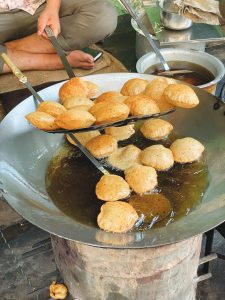
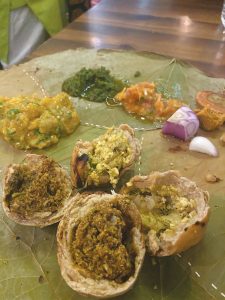
Benares is a gastronomic melting pot, especially for street-food lovers. I distinctly remember the sheer joy, and the utter abandon (no one counted their calorie intake back in the day!) of devouring piping-hot hing-dal kachoris, sugar syrup infused desi-ghee malupuas and jalebis on the way home after our early morning temple visits with my grandmother. Food can be nirvana too. Evenings were always reserved for going back to one of the many chaat eateries. They are somewhat of an institution in the city. We frequented the legendary Kashi Chaat Bhandar, and would immediately order their tamatar chaat and dahi chutney golgappe. My first experience of eating palak patta chaat was here, and now decades later it remains a favourite. Gulab jamun was always ordered to end the early evening meal, or “jol khabar” as we Bengalis call it; and these are probably still some of the best I have ever tasted. Sweet like honey, they just melt in your mouth, chewing is unnecessary.
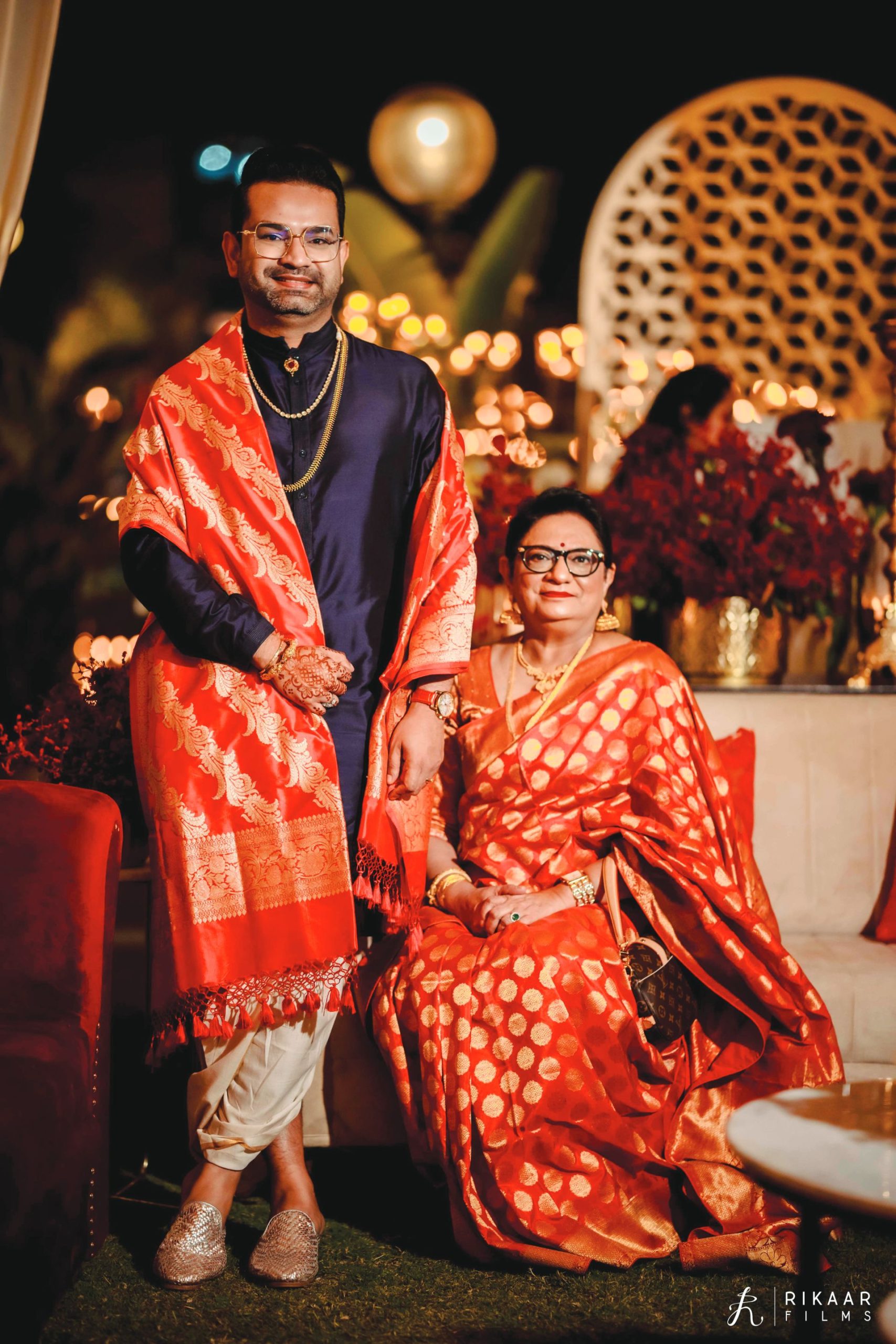
Nimbu chai, and nani’s sarees that Najid wove
Benares, or Kashi as it was known as in earlier eras, is also a city of richly-woven threads of silk, gold and silver. The cultural and community links to woven textile remain an intrinsic part of the city’s identity. From the 2nd century BC, when Patanjal, the great grammarian, in his text Mahabhasya mentioned kasika textiles as being more precious than others, to references in ancient Buddhist and Jain literature that mention Kashi as an important weaving and trading centre, glimpses of this heritage are available through history. With several hundred thousand hands engaged in both weaving and pre- and post-loom activity, the economy of the ancient city is still inextricably connected to the loom.
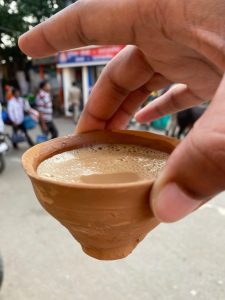
No trip to Benaras ever started off without my grandmother making a day-long visit to the home of her long-trusted saree weaver – Najid. Over several cups of piping hot nimbu chai, she would reminisce about how Najid’s father was a young man when she first met him, during an annual saree buying sojourn with her mother and two younger sisters; she was all of sixteen then.
My grandmother Bani-Banya, was the eldest daughter of Shri Prabodh Kumar Sanyal, a prominent Bengali travel novelist and political journalist of pre-partitioned India. Till date, his series of novels on the godly Himalayas is widely considered as some of the most significant literature ever to be written on the majestic mountain range. As his first born, she accompanied him on important social events and conferences around the world.
Bani adored her woven sarees, carefully collected from across the length and breadth of our country; and on these travels with her dear Baba (sometimes, accompanying even Jawaharlal and Indira Nehru), she apparently always wore a cotton dhakai jamdani during the day, and a silk Benarasi at night.
Later in life her devoted barrister husband, my grandfather, indulged her penchant for delicate gold jewellery and spared no occasion to gift her elaborate necklace sets. Armed with these beloved jewels, she would visit Najid bhai and embark upon custom-creating Benarasi sarees to pair up with them perfectly! She would often also order the same bespoke saree for my mother in a different colour. There is nothing more she enjoyed doing than spending these long, languid, sultry afternoons, sketching out motifs, patterns and intricacies of her sarees.
Initially, I was too young to make sense of it all, and was happily engrossed in playing around with the heaps of silk yardage opened up in front of me on fluffy white gaddas. However, with the passage of years, witnessing my mother and grandmother later wear these one-of-a-kind sarees with pride and grace, I too developed a keen interest in what became an enduring family bond. Slowly but surely, thus began my love affair with the majestic materiality and dexterity of handwoven Benarasi textiles.
Khimkhwab to a coronation gown crafted in a Benares karkhana
I later learnt that textiles which fascinated foreign writers and traders for centuries were not just the sumptuous silk brocades, but also the legendary kimkhwabs –jewel-like cloth of gold and silver, which has been vividly represented through literature and painted art forms.
“The gorgeous and beautiful khimkhwabs and gold brocades from the looms of the holy Banaras” –an exhibit in the catalogue of the landmark Colonial and Indian Exhibition of 1886 in London is described as. The exhibition was inaugurated by Queen Victoria; and showcased the best resources and products from over 33 British dominions.
The mystical Khimkhwabs are now usually specially commissioned, taking two months or more to complete a bolt of four metres! (Often woven as gyasar brocades for Buddhist monasteries across the globe). The densely patterned textile, with auspicious Buddhist symbols and floral imagery, gleams in the richness of real gold and silver dipped silk threads. Usually woven in width of 24 inches, in traditional wooden pit-looms using the discontinuous supplementary warp technique.
Benarasi textile’s legacy is centuries old, though some experts now attribute the history of modern-day Benarasi manufacturing to the Mughal era in India. The weaving community was skilled in producing different types of fabric, including silk, cotton and muslin. However, it was the abundance of mulberry silk in the region that ultimately established silk textiles as the cornerstone of weaving here.
Emperor Akbar sponsored the establishment of royal ateliers or karkhanas throughout the city. Following this, the British East India Company also propelled a significant rise in silk production. Textile manufacturing was one of the most important industries in colonial India and played a significant role in the colony’s economy under the patronage of the likes of Lady Mary Curzon, wife of Marquess Curzon, the Viceroy of India. Lady Curzon was a close friend of Queen Alexandra, wife of King George V of Great Britain and it is widely believed that Queen Alexandra’s coronation gown, under the supervision of Lady Curzon, was designed and crafted in Benaras!
A river meanders, and pilgrims get lost to find…
Varanasi may be the city where Hindus come to find moksha, but it is easy to lose your way. Indian pilgrims, in search of one of many hundreds of mismatched temples, often walk barefoot through labyrinth-like lanes, up narrow steps on the Ganga’s crescent-shaped western bank. The city is one of scholars, home to one of Asia’s largest universities, but above all else, it is a city of myths, including some, which are contradictory, obscure and impossible to prove.
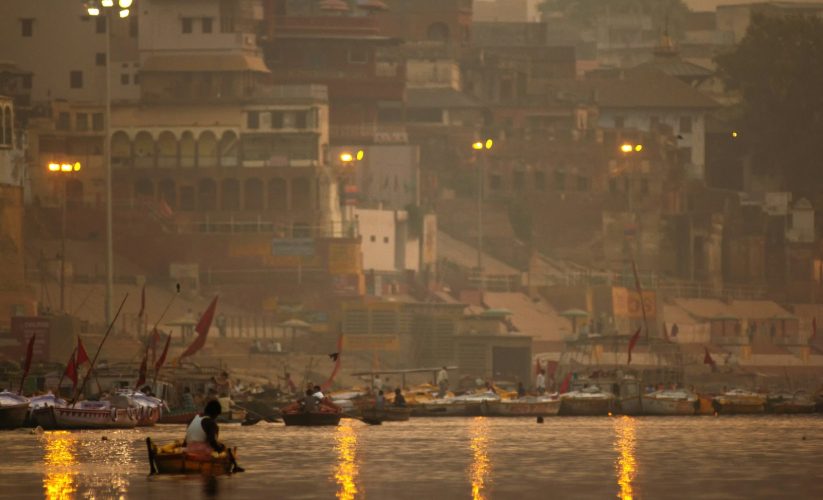
The meandering expanse is best experienced from water, sailing on one of the handcrafted 10-feet-long wooden hand-row boats, locally called “chappu”, often painted with bright colours and traditional designs. The boatmen are perhaps the most poignant sutradhars (narrators) of this historic, complex, magical city.
The most popular time for a boat ride is sunrise, when the surface of the sacred Ganga is aflame and eager bathers line the waterfront. Along the way, you hear stories of the famous ghats – the sandstone embankments of steps that lead from the alleys to the river. Each ghat was constructed by a different medieval king, and each have inspired their own mythology. The Ganga is a living, flowing, all-consuming, technicolor canvas, reflecting the moods and memories of countless lives. It snakes through the timeless city, a place that seems to exist outside the bounds of time.
In the mist-covered serenity of dawn, I soak in the crisp air brimming with reverence. The muffled chants of priests, the clinking of bells, and the rhythmic splash of oars blend into a symphony…. Suddenly, a sharp sensation runs down my spine. My gaze, as though guided by an unseen hand, is drawn to the flames leaping from the burning pyres at Manikarnika Ghat. Here, the line between life and death blurs, dissolving like ashes carried by the gentle waves. Splattered petals drift alongside the charred remains of human journeys, both meeting the Ganga with equal reverence.
Tears well up in my eyes, unbidden, as if the river itself whispers stories—each life, a flickering ember surrendered to the divine flow. The skyline shifts as the sun rises over the ghat. Golden rays scatter across the river’s surface, painting the city in orange and crimson. Slowly, Benares wakes. The ghats come alive with saffron-clad sadhus, flower vendors, and pilgrims performing their ablutions, seeking absolution in the sacred waters. In this moment, I stand in awe. The city and the river are one, weaving together life, death, devotion, and transcendence. And I feel both the weight of eternity and the fleeting breath of existence.