October 22, 2026
INSIDE COSTA NAVARINO GREECE’S  HIDDEN GEM

INSIDE COSTA NAVARINO GREECE’S HIDDEN GEM

If you want to skip the islands, the cruise ships, and the touristy lot, the luxury
development of Costa Navarino in Messinia can be your enchanting under-the-radar
getaway. As direct flights start from India to Athens in early 2026, delve into Greek
philosophy and gastronomy, under the shade of a thousand Olive trees.


By TFTA Travel Desk
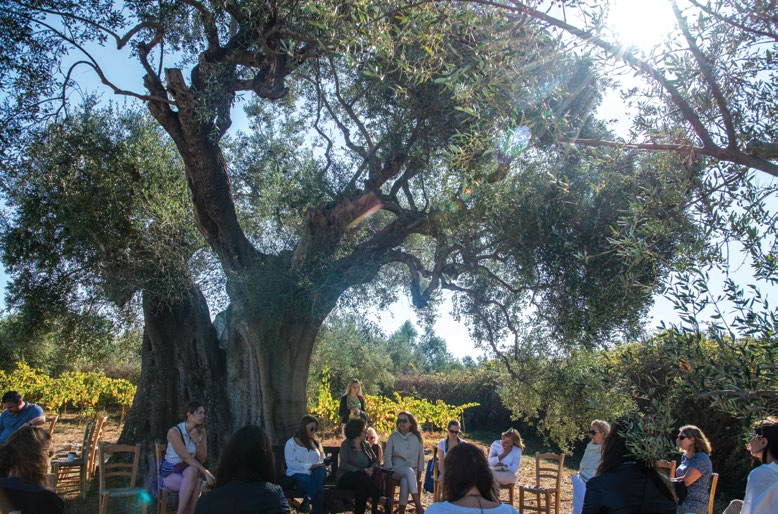
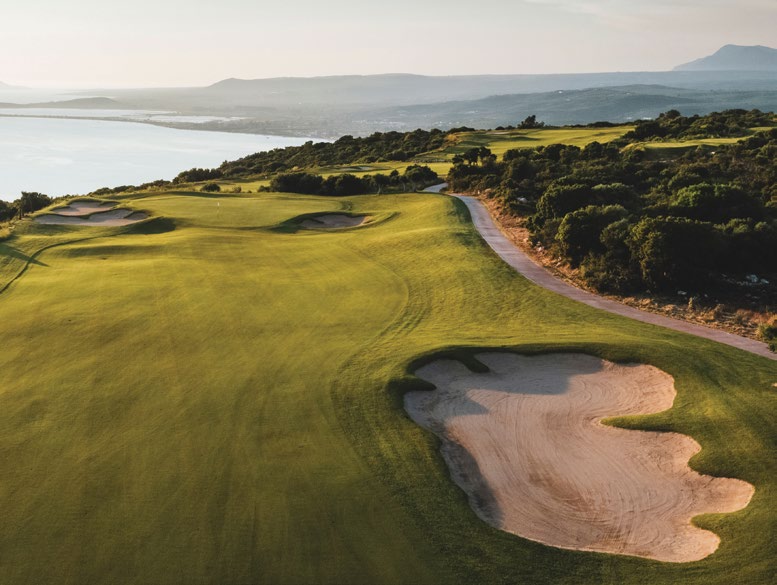
A thousand-year-old Olive tree shades us at the edge of one of the most beautiful golf courses in the world. As the afternoon wanes, we sit under it, cooled by the salty air of the Ionian sea lapping this ancient part of the world– and discuss Socrates, Plato and Aristotle, the three Greek philosophers whose ideas have been borrowed over the centuries and continue to define the modern world’s thought, philosophy and politics.
The discussion is with a contemporary Greek philosopher—an academic from the University of Kalamata who has driven 45 minutes from the port city and capital of the region, to reach us in this hidden part of Messinia, the southwest corner of the Peloponnese (peninsular Greece), and to have a conversation on the modern day’s many problems in the context of Aristotelian thought. We bring up a bit of Chanakya, and land up discussing the ancient connections between India and the Hellenic world, and realise with a pang how valuable this moment is in a day when conversations are fading, and Gen Alpha speak and emojis reducing our capacity for depth.
“The Philosophy Walk” inspired by the ancient Greek practice of philosophers discussing ideas while talking, similar to Aristotle’s Lyceum, is one of the most unusual experiences you can sign up for — if you choose to vacation at Costa Navarino, here in this hidden part of Greece, the idyllic and ancient Messinian countryside, away from tracks more tread, selfies more clicked. It’s a discrete development that is currently having a moment under the sun in the world of upscale experiential travel even though it is as yet undiscovered by Indians (though Nita Ambani apparently did visit last year, as we were told).
“I get a lot of investment bankers, entreprenuers and sometimes even their children who want to know what the Greek philosophers thought and whether it is possible to solve the current world’s issues in the light of that thought”, says the university professor leading our discussion, as we talk about the idea of “happiness” and what makes for a happy society, as per Socrates, Plato and Aristotle, and realise that some of it is similar to the philosophic Gita ideal of following one’s own “dharma”— or unique “purpose”, as is loosely translated.
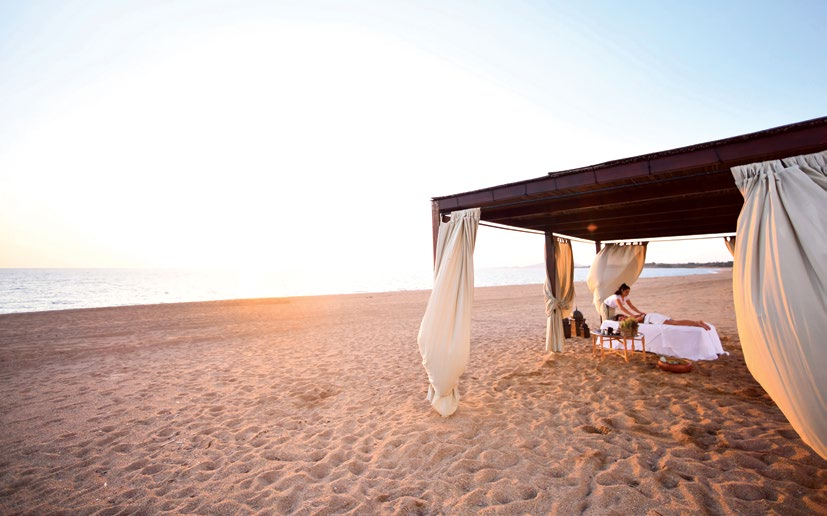
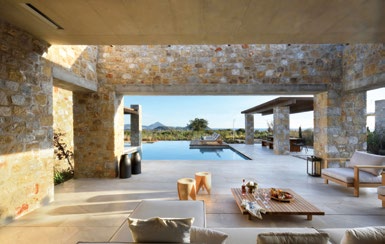
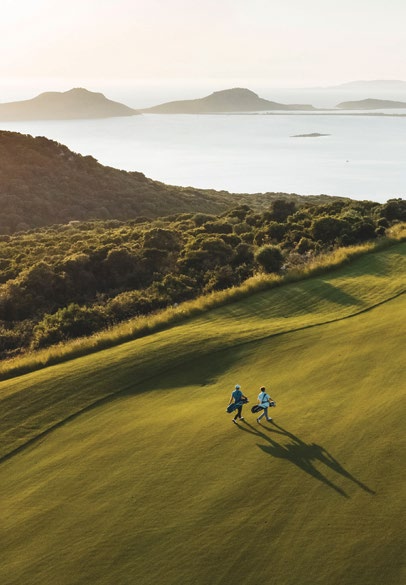
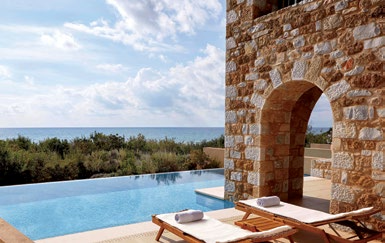
There are four resorts within the huge Costa Navarino development, embracing three distinct areas near Pylos, an ancient port of Messinia. Westin Resort caters to a family audience, with its meandering pools and suites with pools. There’s The Romanos, W Costa Navarino, which is adult’s only and LGBTQ friendly, and the latest, a Mandarin Oriental that opened in 2023. Then there are over 40 restaurants, wine bars, cafes, pristine beaches, agoras (market places), wine clubs, an open air cinema, spas, not one but four, 18-hole, world-class golf courses and more, all embracing the sea and the mountains, fringed by thousands of Olive trees. And guests move between all, sampling, sipping, sporting… a holiday unlike any other.
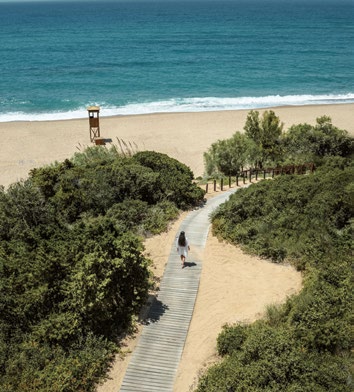
The beaches are mesmerising —clean, empty and testimony to the fact that if you go off the beaten track there are so many more undiscovered idylls than those influencers advertise. You could sit building sand castles, enjoying long lunches and dinners in chic shack-like restaurants, and then there are the host of seriously prestigious sports: world class golf, an NBA basketball school for both kids and adults, fashionable pickle ball, and tennis courts – with a Mouratoglou tennis centre, founded by Patrick Mouratoglou who coached serena Williams. However, what makes Costa Navarino distinct is its strong roots in the Messinian way of life that you get immersed in while you are here.

The Messinian Life

Messinia is a region in southwest Peloponnese with Kalamata
as the Capital, and some of the oldest historical sites in Greece:
Olympia, Koroni, ancient Messene and Pylos. The region is
mentioned in the Homeric epics, The Iliad, and The Odyssey,
as ruled by King Nestor, who is visited by Telemachus, the son of the wandering Odysseus, in his
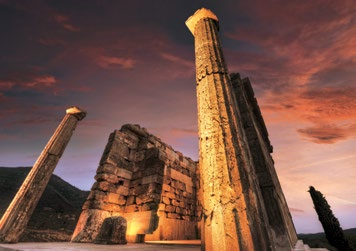
palace. The Mycenean-era (1750-1050 BC)
palace of Nestor has been excavated at
Pylos, and is just 15 minutes away from
Costa Navarino, open to the public since
2016. Apart from amphorae for wine, a
drainage system, a bathtub, the queen’s
quarters separate from the king’s and so
on, the two storey palace with gorgeous
views of the mountainous coast and the
Navarino bay, also contained a tablet
with the Linear B script — a form of ancient Greek, whose
influence extends far beyond the Greek-Latin worlds to the
entire Western civilisation.

There are a host of
seriously prestigious
sporting facilities: world
class golf courses,
NBA basketball school,
and the Mouratoglou
tennis centre
At the W resort, that is filled with art curated by Poka-Yio, founder of the Athens biennale, Linear B is a motif in some of the installations evoking a sense of history. This sense of roots is in fact pervasive all through Costa Navarino– unusual for modern resorts or “integrated resorts”, the latest buzzword in hospitality. Whether it is restaurants celebrating Messinian produce and recipes, Olive oil tastings that can be arranged for you to help you distinguish supermarket olive oil from “liquid gold” (this after all is the world’s best region for olives and olive oil), local materials used in the construction and design of the hotels, or indeed a silk scarf that you may buy, everything has a local connect.
When Costa Navarino owner Captain Vassilis Constantakopoulos, a ship owner and a local legend, started building his first hotel in 2010, after having bought land from his shipping profits, piece by piece for years, the vision was clear. This was going to be a love letter to Messinia: to put it on the map. Fifteen years later, as the world’s well-to-do walks in, the idea is in motion

Olives, Feta, wine and Taramasalata


The first day we are there, the sky a glorious blue, the sea
cooling the summer heat so that this is much cooler than
Athens, we go to lunch at a restaurant that became ostensibly
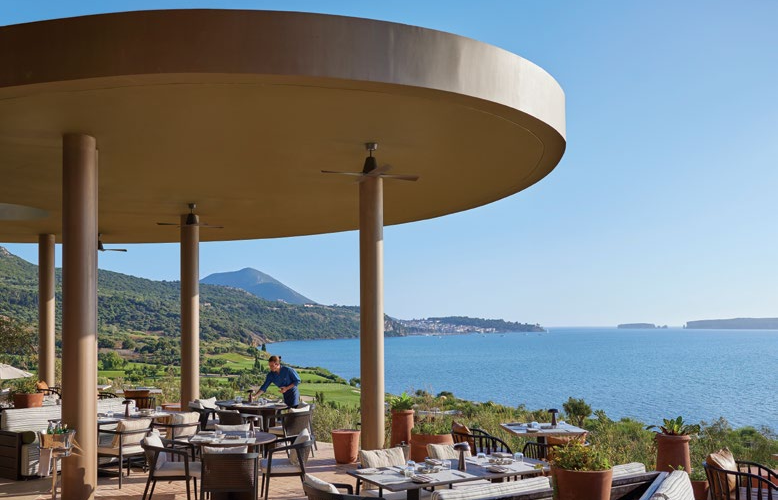
an Instagram sensation as the most beautiful in Greece! In a
rare occurrence, this wasn’t an exaggeration at all! Barbouni
(named after the Greek word for red mullet, a beloved local
fish in the cuisine) is a picture perfect beach restaurant at the
Westin Costa Navarino. It’s ridged canopy ceiling became
an internet sensation a few years ago—movable in the wind,
which is a powerful element here on this coast. The turquoise
waters, perfect in the glistening sun, form a perfect view for
our seafood lunch that comprises of octopus, oysters, Orzo
with blue crab, a seafood linguine, as also the freshest tomato
salad with feta, a generous drizzle of olive oil, capers and caper leaf. Local tomatoes are in season
and their taste in unmatched. There’s also
taramasalata, the Messinian fish roe salad/
dip that comes with local breads. It’s the
perfect beginning to a Greek holiday—a
two hour lunch, that can only be followed
by a nap!
The big black Kalamata olives are a part of every meal in the days to follow. But we soon learn that these are not the olives local farmers use to make olive oil from. Messinian olive oil is equally world famous and known for its high quality, and uses another local variety, the Koroneiki, which yields rich, fruity oil with a peppery finish, and low on acidity. That afternoon, we have an instructive oil tasting session with a local expert, and are immediately able to discern the difference between a “supermarket” oil and the local one, made from olives grown right here in the centuries’ old groves.
Wines from the Peloponnese are distinct from what you may find anywhere else, including in Santorini
Wines from the Peloponnese are equally full of character and distinct from what you may find anywhere else, including in Greece. When you think of Greek wine, it is wines from Santorini and Crete that are the best known. But the Peloponnese has some good ones too, made from local and ancient grape varieties. I did a comparative tasting at the new Cellier (it is one of the biggest wine retailers in Greece) wine bar that has just opened at the Navarino Bay Agora, and loved the wines from Nemea made by the well-known Gaia winery (not Gaja, the Piedmontese heavyweight) with its private vineyard in Koutsi. The red wine is made from Agiorgitiko grape, and oaked. It’s a wine quite similar to Sangiovese and just as suited to Indian palates that prefer well-rounded fruitiness with a hint of spice.
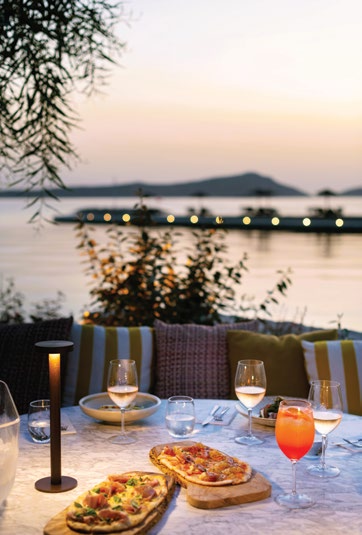
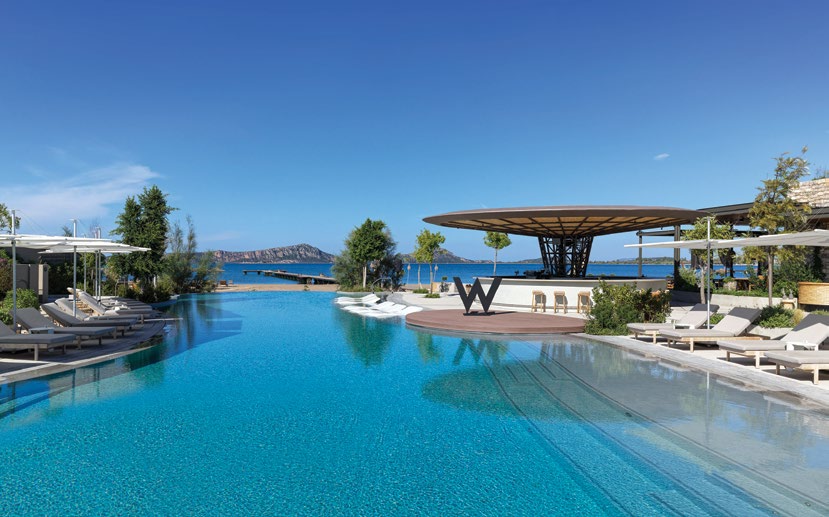
The W Costa Navarino is the first (and only) W hotel in Greece, with a fabulous location on the sweeping arch of the Ionian coast, near Pylos, the charming and ancient port where you will get some of the best sea views of this Greek coast. Parelia, a Greek inspired beach club and restaurant at the hotel, is trendy, and offers chic gentrified takes on local recipes, as well as spectacular grills with the local catch that is brought to the table to be inspected. Our neighbouring table one evening chooses a humungous red snapper that had the entire restaurant craning their necks for a dekko. We, in the meanwhile, asked for the scarilynamed “scorpion fish”, which has often been described as one of the world’s most venomous species. It is supposed to be a rare delicacy—and is 100 per cent safe to eat. In fact, babies in this part of the world are often fed broth made with the mild and sweet flesh. The fabulous views, a long Instagrammable pier, island bars and DJ beats later in the evenings make this quite the party spot in keeping with the W’s positioning as a brand. You can go to the party, and bring here your own party!

Ps. The Lunch in Pylos


One afternoon, we drive down to Pylos, taking in the ancient
ruins, and then making our way to the town square for a bit
of shopping and just soaking in the Med vibe. Pylos reminds
me of the South of France with more languor and no tourists.
You can see the yachts bobbing in the ocean below. There are
sweeping views of the deep blue all across, and just a small
town where neighbours have gathered for a beer and a few
bites at tables propped up in the town centre. We eat the local
spicy sausage, some meatballs and of course copious amount
of bread and olive oil, drink beer, and a few Frappes, browse
around in the local stores full of silver jewellery and silk
drapes. But mostly, we just see the sea and soak in the vibe.
It’s a med day, a dreamy one.
Avatar photo
About Author

FTAlmanac

Previous Post

Leave a Reply